Get Full Government Meeting Transcripts, Videos, & Alerts Forever!
Get email alerts on the Waterfowl Research topic
No spam. Unsubscribe anytime.
Vermont migratory game bird biologist details waterfowl tracking, population findings and shifting migration patterns
Summary
Andrew Bhutan of Vermont Fish and Wildlife summarized multi-state tracking projects, recent transmitter and geolocator deployments, and observed migration shifts tied to warming temperatures; he said black duck numbers have risen in recent years and avian flu has caused localized die‑offs but not population‑level declines.
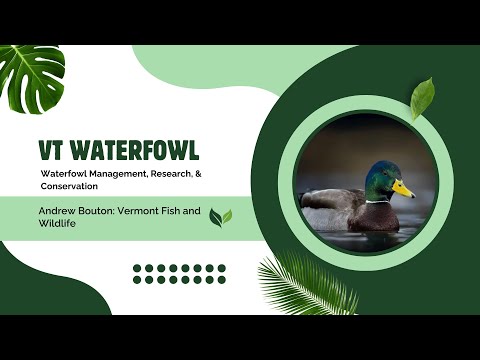
Andrew Bhutan, Vermont Fish and Wildlife’s state migratory game bird biologist, gave a public presentation on the agency’s waterfowl tracking and research efforts, describing years of transmitter and geolocator deployments across the Atlantic Flyway and explaining how those data inform season-setting and conservation.
Bhutan said waterfowl are managed across states, provinces and countries under federal frameworks and flyway processes, and that biologists compile multiple data sources — breeding-plot surveys, aerial counts, parts‑collection (wing) surveys and banding — to estimate populations and make technical recommendations. "We work with Canada and Mexico," he said, describing the Atlantic Flyway council and technical sections that meet twice a year to review data and make recommendations that later feed into Service regulations and state season-setting.
The presentation detailed field methods and recent device deployments. Bhutan described capture techniques (drive trapping for geese during flightless periods, rocket nets and walk‑in traps for ducks, night‑lighting from airboats and mist‑netting for sea ducks) and device types, including GPS transmitters with solar panels and smaller leg‑mounted geolocators. He said Vermont contributed to a regional effort, deploying 8 GPS transmitters in 2022, 13 in 2023 (plus geolocators), three transmitters and 13 geolocators in 2024, and 16 geolocators in 2025, and that additional units were ready to deploy in the coming weeks.
On collaborative research, Bhutan summarized the Eastern Mallard Research Collaborative’s aims “to better understand breeding survival and habitat usage, quantify and compare female mallard movements and habitat use throughout their annual cycle” and said the collaborative has marked more than 1,200 female mallards and in 2023 deployed about 610 GPS transmitters and over 400 geolocators across the flyway.
Bhutan used movement maps to show seasonal timing: birds begin larger southbound movements in October, concentrate in open‑water wintering areas such as Lake Champlain, and show nesting‑site fidelity in spring and summer. He explained distinctions among waterfowl groups and local species patterns — for example, that several eider species are essentially never observed in Vermont and that some tree‑duck species are primarily Gulf Coast birds.
In a question‑and‑answer period, Bhutan addressed population trends, disease and management. "Black duck populations have actually gone up the last five or six years," he said, adding that past declines are now thought to have been driven largely by habitat loss rather than hybridization. On avian influenza, Bhutan said it has caused isolated die‑offs (he cited an instance of 30–40 dead geese found at Button Bay last winter) but “hasn't caused a decline in the populations” at the broad scale so far. Asked whether a moratorium on waterfowl hunting would increase populations, he said current research indicates waterfowl hunting on ducks is largely compensatory and a moratorium would likely not raise populations at large, though geese (a longer‑lived species) behave differently.
Bhutan also described shifts in migration linked to warming winters: "It's becoming quite apparent in the Midwest, where ducks and geese are no longer migrating as far south," he said, noting hunters and managers in different regions are disputing causes and effects as birds ‘short‑stop’ where open water remains. He attributed some snow‑goose flyway changes to altered farming practices and waste‑grain availability that shifted stopover and wintering patterns.
The presentation concluded with Bhutan inviting questions; he said more devices were ready to deploy and emphasized that flyway coordination, multiple survey streams and ongoing telemetry are central to setting seasons and managing populations going forward.