Get Full Government Meeting Transcripts, Videos, & Alerts Forever!
Get email alerts on the Solar Decommissioning topic
No spam. Unsubscribe anytime.
County environmental director urges statewide plan for solar decommissioning, warns cleanup could fall to taxpayers
Summary
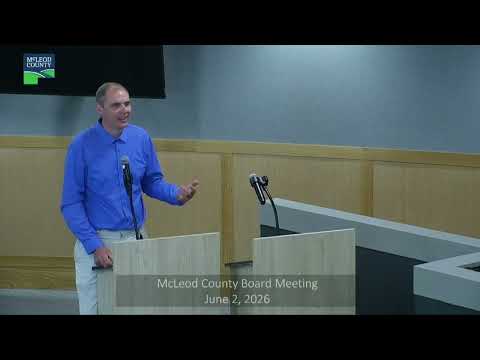
At the June 2 McLeod County meeting, Environmental Services Director Mark Tleki told the board a statewide working group is developing standards for solar‑panel disposal and financial assurance after raising concerns that large solar gardens could exceed county authority and leave taxpayers to pay for cleanups.
At the June 2 meeting of the McLeod County Board of Commissioners, Environmental Services Director Mark Tleki briefed the board on a statewide effort to address solar‑panel disposal, siting and financial assurance for large solar gardens.
Tleki said counties can regulate smaller projects but not arrays that exceed roughly an 80‑megawatt threshold, which fall under the Minnesota Public Utilities Commission. He said the county is participating in a multi‑agency working group including MPCA, the Department of Commerce, the PUC and other state offices to develop consistent approaches to decommissioning and to create a central clearinghouse for recycling or resale of panels.
Why it matters: large, outstate solar installations can include thousands of panels and, if damaged by storms or left at end of life, produce volumes of e‑waste local governments are not positioned to process. Tleki told the board his research — including pricing from the National Renewable Energy Laboratory — supported a working estimate of about $50 per panel for recycling, but he emphasized that figure may change with inflation and technology shifts.
Tleki and commissioners focused on two practical risks: (1) whether required financial assurance (bonds, letters of credit or escrow) will keep pace with inflation over 30‑ to 40‑year project lives, and (2) the administrative burden of collecting on a bond if a company dissolves. "If the entity bankrupts the LLC and we have to collect on that bond, it becomes significant work for our attorneys," Tleki said. He added that counties want to avoid a situation where taxpayers are left with cleanup costs.
Commissioners pressed on specifics: how often residential panels have been returned (staff said only occasional residential calls), whether bond or cash escrow is better (staff said the county generally prefers a bond to avoid long‑term escrow ownership questions) and whether the PUC will respect county ordinance performance standards for siting. Tleki said the PUC has indicated it will consider local performance standards, but counties have not yet faced a large project in McLeod County that would test that interaction.
Board members also discussed the potential for large projects to secure transmission easements or cluster near landfills, and they asked staff to notify the board if an imminent large project is proposed so the board can comment to state regulators.
Next steps: the working group continues to refine draft policy and proposed legislation; Tleki said he will report back to the board and notify commissioners when a specific project or PUC filing appears that may affect county authority.