Get Full Government Meeting Transcripts, Videos, & Alerts Forever!
Get email alerts on the Ev Charging topic
No spam. Unsubscribe anytime.
Cross Plains committee hears EV charging assessment, targets village hall for imminent grant application
Summary
SRF Consulting presented a needs assessment recommending five candidate sites for public EV chargers in Cross Plains and urged the village to apply to Dane County’s Charge Up Round 3 (deadline April 2). Committee members favored the new municipal campus as the primary grant host site while discussing tradeoffs between lower‑cost level‑2 chargers and costlier DC fast chargers.
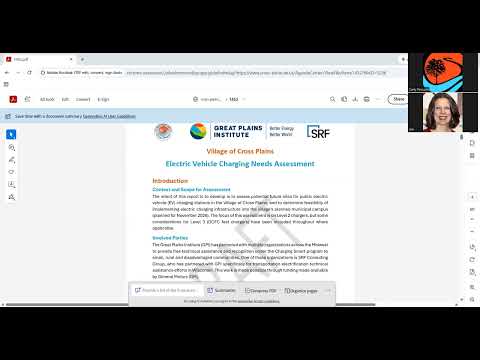
SRF Consulting presented an electric vehicle (EV) charging needs assessment to the Cross Plains Sustainability Committee on March 11 that recommends several public sites in the village and urges the municipality to apply to Dane County’s Charge Up Round 3, which has an April 2 application deadline.
"We’ve partnered with the Great Plains Institute to provide technical assistance for transportation electrification in smaller communities," said Alexander Brown, a transportation planner with the consulting team. Brown said the study focused on publicly accessible level‑2 charging locations and on how the new municipal campus could accommodate chargers as it is built.
The consultants said they evaluated candidate locations using a rubric that prioritized community destinations with at least 30 minutes of dwell time, proximity to multifamily housing, off‑street parking, ADA accessibility, lighting and safety, amenity support (restrooms and indoor space during winter), regular hours and geographic distribution. Using those criteria, SRF recommended five priority sites: the downtown/Ice Age Trail public parking (near Mill Creek/US‑14), the Quick Trip (noting the company already has a charging program), Vintage Brewing Company, the UW Health Cross Plains clinic and Bayer Park.
Alexandria, a planner on the SRF team, told the committee that Dane County has set aside roughly $13.22 million from federal infrastructure funds for countywide level‑2 charger installations and that the Charge Up program’s current RFP is limited to level‑2 equipment for host sites. "That deadline is April 2," she said, stressing the need to identify a preferred host location promptly.
Committee members debated whether to prioritize fewer, faster DC fast chargers (level‑3) or more level‑2 chargers. "I would rather go fewer chargers and have them be level‑3s than a lot of level‑2s," one committee member said, arguing that faster chargers better serve short‑stop visitors. The consultants and other members responded that level‑3 equipment requires substantial electrical upgrades (step‑up transformers) and is not eligible under the imminent Dane County round; level‑2 installations are more commonly funded by available local and county programs.
Members discussed specific site details, including parking availability and ADA requirements for a previously considered downtown lot and a bank parking lot across from Vintage Brewing Company that had not been included on the presentation map but will be added in the next draft. The consultants also noted the library has 24‑hour Wi‑Fi visible from the street, a practical amenity for drivers charging their vehicles outside building hours, but that the library’s off‑street parking and lighting lower its rubric score compared with downtown sites.
On balance, the committee agreed to prioritize the new municipal campus (village hall) as the lead site for the upcoming Dane County application because it is publicly owned, appears to meet several rubric priorities and would allow the village to incorporate conduit during ongoing construction. Committee members instructed staff to move forward with an application for that site and to coordinate conduit and transformer placement during the campus build to reduce later retrofit costs.
Next steps: staff (Carly) was asked to prepare an application for Charge Up Round 3 and to coordinate with SRF and the utility on final site details. The committee also planned to integrate EV charging recommendations into the village’s sustainability/comprehensive plan work ahead of a September planning commission deadline.