Get Full Government Meeting Transcripts, Videos, & Alerts Forever!
Get email alerts on the Land Use Subdivision topic
No spam. Unsubscribe anytime.
Planning commission recommends no dry sewer for Rosewood Estates, requires curb-and-gutter and storm sewer
Summary
On June 8 the Norwalk Planning & Zoning Commission voted to recommend that city council approve the preliminary plat for Rosewood Estates with a condition: do not require a dry sewer; require curb-and-gutter and storm sewer instead. The decision reflects staff engineering concerns about gravity sewer feasibility and cost considerations raised by the developer.
On June 8 the Norwalk Planning & Zoning Commission recommended that city council approve Marco Properties LLC’s preliminary plat for Rosewood Estates with two conditions: the city would not require a dry sewer to be installed now, and the developer must build curb-and-gutter and a storm sewer cross section.
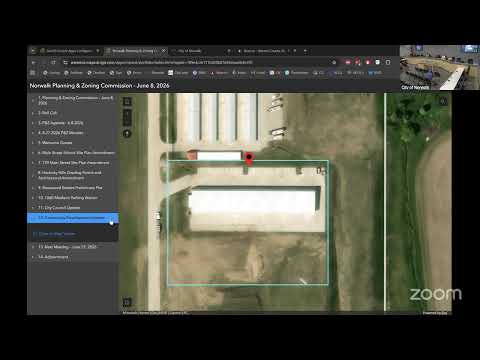
The proposal covers a 42‑lot subdivision located inside the city’s two‑mile planning jurisdiction but outside the municipal limits. Luke, a city planning staff member, told the commission that the site is distant from the city’s trunk sewer, that floodplain and elevation differences make a gravity sewer impractical, and that alternatives such as lift stations carry long‑term maintenance costs. "The easy thing would be to require it, but the developer makes a lot of good points about the really the need and its purpose to sit there for so long that it will never be used," Luke said during the presentation.
Developer representatives and engineers urged flexibility. Brad Cooper, a civil engineer working with the project team, described steep fill and a shale interface that has produced slope failures; Cooper said lowering the grade and switching to walkout units would remove unstable fill and stabilize the slope. Cooper also questioned technical options for piping under the river and said the scale of flow needed for an inverted siphon would not be met by 42 homes. "With 42 lots, you don't even get a fifth of that," Cooper said, arguing that the only feasible sewer solution would be a lift station.
Commissioners discussed costs and long‑term implications. Luke estimated a recent large lift station cost about $1,500,000; Cooper and the developer suggested a much smaller lift station for this subdivision might run in the low hundreds of thousands (one participant referenced roughly $350,000). The developer’s representative also proposed an alternative trade: construct an urban street section (curb, gutter and storm sewer) and contribute $125,000 to the city's parks program in lieu of installing dry sewer.
The commission’s motion — made by a member during discussion and seconded — was to recommend council approval of the preliminary plat with the conditions that the developer not be required to install dry sewer and that curb, gutter and storm sewer be provided. Commissioners called for a roll‑call vote and approved the recommendation.
The recommendation will go to Norwalk City Council for final action. The commission’s report to council will include the engineering findings presented at the meeting and the conditions the commission attached to its recommendation.