Get Full Government Meeting Transcripts, Videos, & Alerts Forever!
Get email alerts on the Land Use Zoning topic
No spam. Unsubscribe anytime.
Plain City holds public hearing on proposed data-center zoning after residents warn of noise, water and health risks
Summary
Residents at a crowded Plain City Council public hearing urged stronger protections in a proposed data-center zoning chapter — calling for larger residential setbacks, tighter noise limits, water caps and even a temporary moratorium — while the council set further deliberation for June 22.
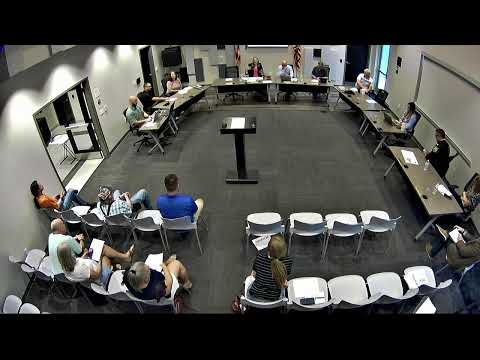
Plain City Council opened a public hearing on a proposed addition to the codified ordinances that would create Chapter 11-88, a new section regulating data centers, and heard more than an hour of public comment Wednesday evening.
Residents raised concerns about noise, water consumption, air emissions and long-term community impacts if the 750-foot residential setback and 1,000-foot setback from waterways in the draft remain unchanged. "At 750 feet, the continuous low-frequency noise will easily penetrate the walls of nearby homes," said Penny Shanky, a software engineer who lives at 500 Carriage Drive, urging the council to adopt a larger buffer and stronger performance standards.
Why it matters: Data centers can be large, resource-intensive facilities. Plain City officials said they currently have no active proposals inside village limits but have seen interest in nearby townships; the draft ordinance aims to give the village a regulatory tool before projects move forward.
At the microphone, Thomas McDaniel, who identified himself as an avid kayaker and outdoors enthusiast, asked the council to increase the 1,000-foot setback from the Big Darby Creek and to reduce the proposed 65-foot maximum height to protect scenic river corridors. "I'd like to see that increased setback in the Big Darby," McDaniel said.
Long-time Plain City resident James Lorenz reviewed technical issues he said the draft does not address: cumulative power demand, water usage, stormwater runoff management and the lack of monitoring requirements. "You don't have any idea how it's going to affect your community," Lorenz said, urging the council to require developers to disclose power and water figures and to impose stormwater containment.
Several residents urged a temporary pause on approvals while independent cumulative-impact studies are completed. Shanky specifically proposed a two-mile residential setback, a 200,000-gallon-per-day cap for commercial water use, and a moratorium until further study; she cited other municipalities that have paused approvals while studies proceed.
Not all comments were technical: Susan Johnson said organized public pressure succeeded in a neighboring county, which placed a moratorium after large public turnouts and signatures; Jennifer Donovan asked whether the village's sound ordinance provides enforceable numeric limits and expressed skepticism that the draft's proposed 750-foot residential setback is adequate to prevent sleep disruption and property-value loss.
Council response and next steps: Mayor (name not given in the record) thanked residents for attending, noted Plain City controls only within its corporate limits, and said staff have been coordinating with state and regional agencies (ODNR and EPA referenced by the mayor) to inform future code language. Council members discussed conditional-use review, PUD pathways and the fact that the village currently has little or no I-2 (limited industrial) zoning inside the corporation limits; legal counsel confirmed that the ordinance amendment process allows later changes and additional public hearings.
The council did not vote on the ordinance; the item was presented as a "first reading" and is set for council deliberation on June 22. Council members repeatedly said the objective is to "get something on the books" so the village has regulatory authority rather than remaining without constraints if an application arrives.
All quotes and attributions above come from speakers who identified themselves during the hearing or were introduced on the record. The hearing included repeated requests for (1) clearer numeric sound limits, (2) explicit limits or monitoring language for power and water use, (3) stormwater/runoff controls, and (4) consideration of a temporary moratorium pending independent study. The council closed the public hearing and scheduled the matter for further consideration at its next meeting.
The hearing record shows strong resident opposition to the draft's current setbacks and monitoring approach and includes repeated calls for regional coordination so that projects outside village limits cannot circumvent local protections. The council's next procedural step is to consider revisions or move the ordinance through second reading after additional staff and planning-commission review.