Get Full Government Meeting Transcripts, Videos, & Alerts Forever!
Get email alerts on the Education Grants topic
No spam. Unsubscribe anytime.
U.S. Department of Education opens 2026 Comprehensive Centers competition; $50 million appropriated, applications due June 30
Summary
The U.S. Department of Education announced the 2026 Comprehensive Centers Program competition with ANIs posted on grants.gov, an application deadline of June 30, 2026, an estimated $50 million appropriation, and award estimates of $750,000–$6.5 million for first-year budgets.
Dr. Michelle Daly, group leader for the Comprehensive Centers Program in the Office of Elementary and Secondary Education at the U.S. Department of Education, opened a pre-application webinar on the department's 2026 Comprehensive Centers Program competition and urged applicants to rely on the official application notice and instructions posted on grants.gov.
"The department is accepting applications through 06/30/2026," Daly said, and directed prospective applicants to the ANIs and the program website for full requirements and resources. She introduced competition managers Erin Kelts and Dr. Esley Newton, who provided details on priorities, eligibility and timelines.
Erin Kelts, competition manager, outlined the program's purpose and network structure, saying the Comprehensive Centers program (authorized in the Education Technical Assistance Act of 2002) is designed to strengthen the capacity of state, regional and local education agencies by providing training and technical assistance to improve instruction and close achievement gaps.
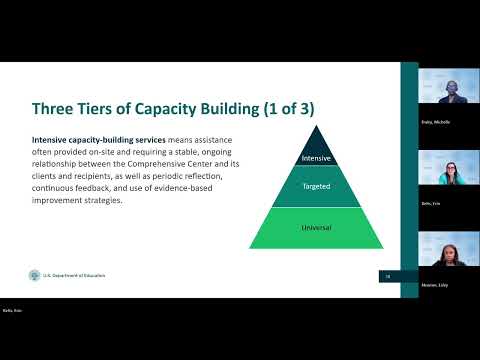
"These centers must provide capacity building services through training and technical assistance aimed at improving educational opportunities and student outcomes," Kelts said, describing three tiers of services—intensive, targeted and universal—and how regional centers will coordinate with Regional Educational Laboratories to align state priorities.
Dr. Esley Newton, co-competition manager, described the two funding tracks in this competition: (1) national, regional, field-initiated and emerging-needs content centers under Assistance Listing Number 84.283B (Grants.gov opportunity EdGrants-050826-001), and (2) a National Center on Improving Literacy for Students with Disabilities under 84.283D (EdGrants-051126-001). Newton said the Department expects to make at least 20 awards (one national center, 15 regional centers, at least three content centers and one national literacy center for students with disabilities) through cooperative agreements with project periods of up to 60 months.
Newton said Congress appropriated $50,000,000 for the program in 2026, with approximately $47,500,000 available for new awards. "The department estimates funding each award ranging between $750,000 and $6,500,000 for the first budget period," he said, and noted funding for later budget periods depends on future appropriations and application-specific estimates in the ANIs.
The ANIs published on grants.gov on 05/08/2026 (and on 05/11/2026 for the literacy center ANI) are the official competition notices, the presenters stressed. Newton outlined the timeline: an optional, nonbinding notice of intent requested by 05/29/2026, applications due in Grants.gov by 11:59 p.m. Eastern Daylight Time on 06/30/2026, peer review of applications in July and August, and potential award announcements in September 2026 if awards are made in this fiscal year.
Kelts summarized the selection criteria and scoring approach—significance, project design and management—with maximum possible scores identified in the ANIs (100 points generally; 110 for the national center) and competitive preference points added where applicable. She also emphasized that applicants must explicitly identify which absolute and competitive preference priorities their proposals address to receive points.
Presenters reiterated application requirements and program obligations that will be detailed in cooperative agreements with awarded grantees, including required performance measurement and reporting under 34 CFR 75.11. Daly closed by reminding applicants to register at SAM.gov and Grants.gov well before submission, to consult posted FAQs and pre-application webinars, and to direct questions to oese.comprehensivecenters@ed.gov.
The department noted applicants should not rely solely on the webinar and must thoroughly read the ANIs on Grants.gov for official application instructions. If awards are made in this fiscal year, the department said award decisions will be announced in September 2026.