Get Full Government Meeting Transcripts, Videos, & Alerts Forever!
Get email alerts on the Trunk Sewer Project topic
No spam. Unsubscribe anytime.
Council debates independent review of Farm Creek trunk sewer after years of delays
Summary
Councilmembers and property owners clashed over how to move the long-delayed Farm Creek trunk sewer interceptor forward. Property owners urged the city to proceed with the previously approved route; staff proposed a local independent engineering review capped at $20,000 while several council members urged renewed compromise talks first.
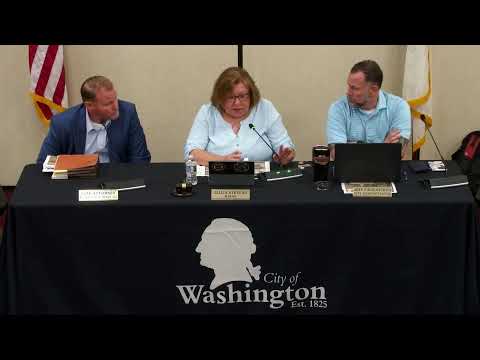
City of Washington council members devoted the longest discussion of the June 8 Committee of the Whole meeting to a long-delayed Farm Creek trunk sewer interceptor project, with residents and council split over whether to pursue a new independent engineering review or to reconvene property owners to seek a negotiated compromise.
At public comment, property owner Chris Hasten said the project began in 2016 and that the city has already spent substantial sums on studies and legal work, listing an initial $541,000 for early work and additional outlays for plan revisions, archaeological and soil studies, I&I smoke testing and other work. Hasten said continued delays have exposed the city to “ongoing IEPA violations” from Farm Creek overflows and urged the council: “It’s time to move forward.” Joe Arnold, another Washington resident, also urged the council not to authorize duplicate studies and asked members to review prior Strand and Hamilton engineering work before approving more spending.
City Administrator Fagan Hsu framed the staff recommendation as a procedural step: authorize the administrator to execute an agreement with Maurer Stutz for an independent engineering review of Phase 2B of the trunk interceptor not to exceed $20,000, with additional fees billed at $250 an hour, and to direct staff to continue advancing route selection, easement acquisition, engineering design, IEPA permitting, funding and construction. Hsu said multiple route evaluations have been completed and stressed that “a route must be approved by the council so the project can advance to final design, permitting, funding, and ultimately construction.”
Council members split on the approach. Several members, including Aldersons McIntyre, Ernst and others, said they preferred bringing both sides back to the table to attempt a negotiated compromise before spending more money on another study. McIntyre and Ernst questioned the value of yet another review after prior work by Strand Associates and Hamilton Engineering; they urged staff to try to broker a joint meeting among involved parties. Moss, a council member, said he would support either a renewed compromise process or a third-party review if the study would be absolutely impartial and likely to reduce future legal costs.
Others acknowledged that prior work had not resolved all questions: council members noted the Hamilton review had paused for I&I smoke testing and that the city never received a finalized, stamped report in council files. Several members told staff to first attempt a joint meeting with property owners (the Putik/Pewdieck family was mentioned as a party objecting to certain alignments) and to return to council if those efforts fail; if parties will not meet, the council said it would consider moving forward with the Maurer Stutz engagement at next week’s council meeting.
The committee did not take a binding vote on the Maurer Stutz authorization on June 8; staff said the item would be placed on next week’s council agenda for possible action. Hsu told the committee staff would reach out “tomorrow or Wednesday” to schedule meetings with the parties and the city attorney and mayor if both sides agreed to meet. Next steps identified by staff include completing route selection, easement negotiations, final engineering design, IEPA permitting and identifying funding for construction.
Claims and context from the meeting: residents and some council members cited multiple prior studies (Strand Associates, Hamilton Engineering and earlier smoke-testing and I&I work), a history of delays and legal costs, and an asserted cumulative local expenditure they characterized as “well over $500,000” beyond initial studies; those amounts and exact accounting were presented by public commenters and not independently verified in the meeting record. The city emphasized procedural dependencies: design must precede IEPA permitting and funding applications.
The Committee has directed staff to attempt joint meetings with both property-owner parties and to report back; absent agreement from the parties, the council may be asked to authorize the Maurer Stutz review at next week’s meeting.