Get Full Government Meeting Transcripts, Videos, & Alerts Forever!
Get email alerts on the Agriculture Operations topic
No spam. Unsubscribe anytime.
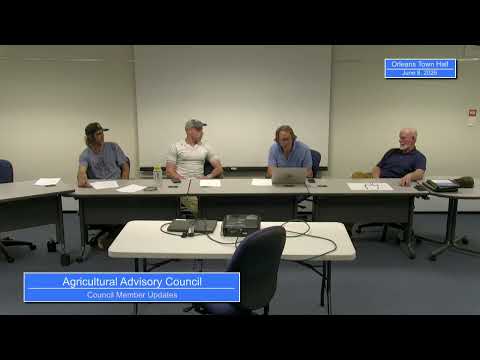
Orleans council hears farmers-market, school-garden and barn updates; growers raise theft and invasive-grass concerns
Summary
Council members reported strong farmers-market attendance, an East Ham Friday market launch, barn construction progress, school garden grants and plant donations, and raised a grower’s report of plot harvesting and an increase in invasive velvet grass near wetlands.
Council members provided a series of operational updates on local agriculture projects, reporting a healthy farmers market season, the launch of an East Ham Friday market at the Tea Time property on Route 6, progress on the new barn project, and grant-supported school-garden activity.
Members said the farmers market "is doing very well" and noted the new East Ham market will run Friday mornings to avoid competing with other markets. The idea of a Put(n)ham growers cooperative resurfaced; members said Natasha Yanuti had identified grant funding through the school farm-to-school program that could support a cooperative (for example, group insurance and coordinated sales to schools) but staffing and logistics for a Put(n)ham table at markets remain unresolved.
Drewie, who provided a construction update, said the barn superstructure is up, equipment is locked inside, water and power hookups are functional, and the freezer and solar meter are pending installation. "We've got a whole bunch of material in there right now. It's locked up tight because we've got a bunch of equipment that was ordered that came in and is inside the barn," Drewie said, adding that training and access procedures will be advertised when the barn is ready (likely late July).
Members also discussed school-garden activity: a NASA Garden Club grant funded blueberry bushes, a Cape Cod 5 mini-grant supplied tree seedlings used in a community plant sale, and a new grant is expected to support middle-school hydroponics and volunteer coordination across K–12 classrooms.
Operational concerns included a grower’s report that people were harvesting from a community plot without permission; a council member advised the grower to bring the matter to the conservation commission (John Janelle) for follow-up. Members also raised a new invasive-grass issue near the wetland and materials area (referred to in the transcript as "velvet grass") that is approaching seeding stage; the council agreed to consult John and to organize a volunteer removal day via Christina and John's office.
Garden-management technical challenges were discussed at length. Members described efforts to terminate cereal rye cover crop planted on a garden area built over old tennis-court fill (techniques included deep-rooted winter rye, crimping, tarping/solarizing and mechanical removal), noting that crown and root removal may be required before planting but that letting annual rye seed and cutting below the crown is one approach.
Next steps recorded in the meeting included organizing volunteer events to remove invasive grass, advertising barn access and training once equipment is commissioned, and coordinating school-garden grant activities and volunteer support.