Get Full Government Meeting Transcripts, Videos, & Alerts Forever!
Get email alerts on the Municipal Finance topic
No spam. Unsubscribe anytime.
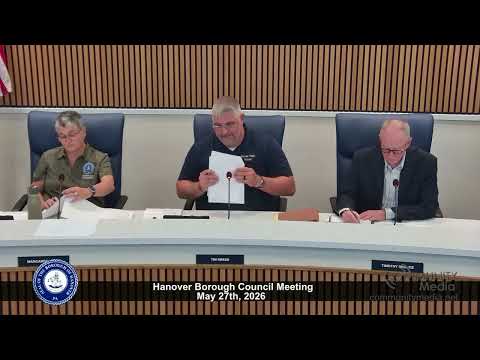
Hanover council adopts bond parameter ordinances to allow future refundings if net savings are met
Summary
The Borough Council adopted two bond parameter ordinances authorizing potential refundings of outstanding bonds (Ord. 2389 up to $9.5M; Ord. 2390 up to $12,050,000). Bond counsel and staff said the transactions will only proceed if a net debt‑service savings threshold of 2% is achieved.
Hanover Borough Council on the motion adopted two bond parameter ordinances that authorize future refunding transactions intended to lower the borough’s debt service if market conditions produce sufficient savings. Ordinance 2389 sets a maximum aggregate principal of $9,500,000 to permit refunding of the borough’s Series A of 2020; Ordinance 2390 sets a maximum aggregate principal of $12,050,000 to permit refunding of Series D of 2020 and a 2025A note.
Bond counsel Jennifer Karen told the council the ordinances are parameter ordinances: they establish maximum principal and interest parameters and authorize staff to accept a bond purchase agreement and an addendum only if specified conditions are met. “The purpose of these refundings is not to extend any debt that’s already existing,” Karen said, and she emphasized the transactions will not proceed unless the borough realizes a net debt‑service savings that meets a 2% threshold, net of issuance costs.
During extended questioning, council members asked why Schedule A’s maximum principal amounts exceed current outstanding balances and why the ordinances contain what some called a large buffer. Karen and other officials said the buffer gives underwriters flexibility to price bonds across maturities when they go to market, and that the 2% net savings test must be satisfied before any addendum is executed. A council member summarized the expected local benefit: at the target 2% net savings the borough could save “probably around a couple hundred thousand” dollars, though the exact amount would depend on market rates and which maturities are refunded.
Council members insisted the ordinances do not create new borrowing or extend maturities. As one council member put it, “we’re not borrowing anything more; we’re taking existing debt and refinancing it at a lower interest rate.” Staff also said the borough’s financial advisor (PFM) has a fiduciary duty to recommend only transactions that benefit the borough; the underwriter (PNC) would market the bonds.
The council moved, seconded and adopted Ordinance 2389 and Ordinance 2390 by roll call vote; both votes were recorded as unanimous. Next steps: if market conditions permit and the 2% net savings threshold is met, the president is authorized to execute an addendum to the bond purchase agreement and the borough will proceed to closing under the parameters established by the ordinances.