Get Full Government Meeting Transcripts, Videos, & Alerts Forever!
Get email alerts on the Municipal Budgeting topic
No spam. Unsubscribe anytime.
Concord finance committee launches five‑part ‘town deep dive’ on operations, debt and budgeting
Summary
The Concord Finance Committee on June 4 kicked off a five‑meeting ‘town deep dive’ to understand municipal operations, enterprise funds, staffing and long‑term liabilities; town staff outlined budgeting, pension/OPEB status and a priority‑based budgeting pilot.
The Concord Finance Committee opened a five‑part “town deep dive” series on June 4, with town staff giving an overview of government structure, budget accounting and long‑term liabilities and with the committee scheduling a separate debt deep dive to model capacity for future capital projects.
Town manager Carrie Flur (presenting the overview) told the committee the series is intended to help members “understand all that the town does with that budget,” emphasizing that the goal is learning municipal operations rather than conducting a line‑by‑line budget review. The presentations will cover departments including planning and land management, human services, public safety and public works over the next several meetings.
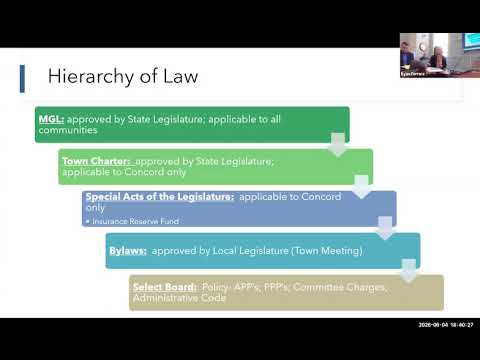
Flur walked members through how state law and local charters interact in Concord’s governance, citing Mass. General Laws (MGL) as the operative framework and pointing to frequently referenced chapters (education Chapter 70; roads Chapter 90; procurement Chapter 30B; finance Chapter 44; zoning Chapters 40A/40B). She also distinguished bylaws (town meeting law) from finance committee policy and described advisory versus regulatory boards, noting the light plant board currently retains rate‑setting authority while most panels are advisory.
On staffing and internal services, the town presented an organizational snapshot showing roughly 252.58 general‑fund FTE and about 81 FTE in enterprise funds. Staff explained that many back‑office functions — payroll, HR and treasury — reside in the general fund and are charged back to enterprise funds as revenues, which can complicate guideline calculations because the expense is budgeted in the general fund while the reimbursement is recorded as revenue.
The presentations also addressed retiree and pension liabilities. Staff reported the town’s OPEB (other post‑employment benefits) trust is about 65% funded, with a level funding plan that the administration says will reach full funding on the current schedule around 2038; the presentation cited an annual contribution figure used in the plan. On pensions, staff noted the retirement system currently uses a 6.5% discount rate and walked the committee through sensitivity analysis showing how small changes in assumptions can materially affect the unfunded liability and annual contribution.
Finance staff announced a move toward priority‑based budgeting using ClearGov to shift reporting from line‑item to program‑level costs, with pilot work planned to map major services (for example, separating police patrol costs from community service programming). The stated intent is to make trade‑offs more transparent to the committee and public.
Why it matters: the deep dive is explicitly framed as an educational exercise to inform the committee’s role advising town meeting on budget decisions; the debt deep dive in particular is intended to produce a debt‑capacity model to help the town and the Concord‑Carlisle regional school district plan future capital projects without surprise tax impacts.
What’s next: the committee scheduled staff presentations across the coming meetings and asked for more granular information on stipends/overtime and for an actuarial briefing on pension and OPEB funding. The committee also agreed to coordinate with the Financial Audit Advisory Committee’s June 17 meeting to hear FY25 audit results and to hold a dedicated debt deep‑dive session in the coming weeks.