Bothell presents five-corridor traffic‑calming plan centered on speed cushions; some improvements hinge on grant
Summary
City staff outlined a collector-street safety package concentrating on speed cushions, radar feedback signs and improved crossings for five corridors in Bothell, sought public feedback and said additional measures depend on a state/federal safety grant decision expected in August; construction is targeted for 2027.
City of Bothell transportation staff on Monday described a five‑corridor "collector" project that would rely primarily on speed cushions and other traffic‑calming measures to reduce speeds and improve safety for people walking and biking.
"My name is Cam Sabo. I'm the transportation operations engineer," said Sabo, who opened the presentation and framed the work around Bothell's recently adopted safe‑system vision and the Transportation Safety Plan. Staff said the plan uses collision data from 2016–2022 to prioritize locations with killed or seriously injured (KSI) crashes.
Why it matters: staff said speed is the dominant factor in injury severity and that redesigning corridors to reduce operating speeds is intended to lower the chance that human error leads to severe crashes. The five corridors highlighted include Fitzgerald/27th/240th and East Riverside Drive; each is proposed to receive speed cushions and corridor‑specific treatments. Staff said some enhancements — such as additional school beacons, radar feedback signs and upgraded pedestrian crossings — would be added only if a state or federal safety grant is awarded (the decision is expected in August).
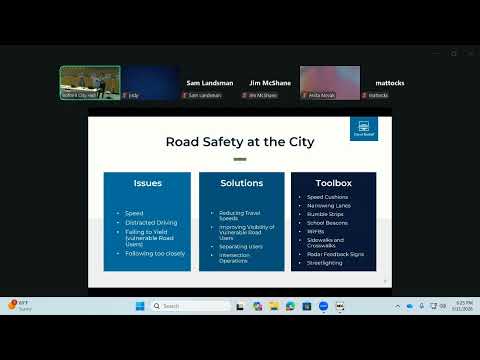
What staff proposed: presenters described a toolbox of measures—speed cushions (designed with wheel paths to allow emergency vehicles to pass), rectangular rapid‑flash beacons (RFBs) at crosswalks, radar speed feedback signs and pavement markings. Sabo said properly designed cushions can reduce typical travel speeds into the high teens or low twenties (miles per hour) and that cushions installed by the city this past year cost roughly $2,500 each when bundled with other work; city estimates place per‑device costs in a roughly $2,500–$4,000 range, while some traffic circles were cited at about $15,000.
Public concerns and staff responses: attendees raised enforcement, signage and travel‑diversion questions. One resident said a family member had been killed at a crossing on 19th Avenue, using that personal tragedy to urge faster action on speed reduction. Staff repeatedly framed the approach as a three‑part strategy: engineering (design changes), education and enforcement, and noted that enforcement remains under police authority. Staff also said the city coordinates signal operation with Snohomish County and is hiring staff to improve signal coordination.
On speed limits: staff said they had not decided to lower posted speeds as part of this project and that changing signs alone often does not change driver behavior; speakers emphasized that engineering changes and the road's visual cues are needed to slow traffic.
Data and evaluation: staff said the Transportation Safety Plan and police crash maps are the data sources for corridor selection and that project effectiveness will be measured with before‑and‑after speeds and collision counts.
Timeline and next steps: staff described the current designs as preliminary (roughly under 30% complete), said they expect to learn the grant outcome in August and aim to begin construction in 2027. Attendees were invited to visit corridor tables with plan sheets, fill out quick yes/no feedback boards and submit written customer action requests or online comments; staff will post materials and recording of the meeting to the project website.
What remains unresolved: several residents urged stronger enforcement and expressed concern about motorists passing slower vehicles around cushions; staff said those complaints are known but that the city had not yet tied those behaviors to confirmed collisions on the corridors proposed for cushions. Staff asked for detailed location input to refine spacing and device placement.
The city closed the presentation and transitioned attendees to staffed stations for corridor‑level feedback and one‑on‑one discussion.
AI generated
The text on this page is AI generated. Summaries, highlights, analysis, and video transcripts are all produced from the original source material.
AI can make mistakes, so if you spot one, and we will fix it for everyone.
Note: the source content is unaltered by us. Any content source we link to, be it a video, an audio recording, or a document, is presented exactly as its publisher released it. That publisher is usually a government body, sometimes an individual official or another organisation.