Get Full Government Meeting Transcripts, Videos, & Alerts Forever!
Get email alerts on the Ocean Outfall topic
No spam. Unsubscribe anytime.
Falmouth board votes to send draft ocean outfall DEIR to state, citing nitrogen reductions and tight permit schedule
Summary
After months of technical review, the Falmouth Select Board voted to submit the draft environmental impact report for a proposed ocean outfall to MEPA, saying tertiary treatment and modeled mixing mean the plan would reduce nitrogen loads while requiring rigorous permit conditions and public review.
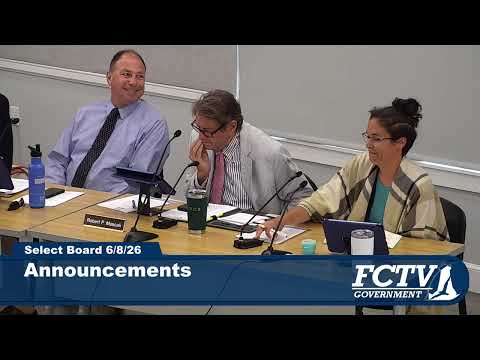
The Falmouth Select Board voted June 8 to submit the town’s draft environmental impact report (DEIR) for a proposed ocean outfall to the Massachusetts Environmental Policy Act (MEPA) office, beginning the formal public and regulatory comment period.
The DEIR, presented by wastewater superintendent Amy Lo, recommends converting the town’s current groundwater discharge to an offshore outfall routed roughly six miles from the wastewater treatment facility to a diffuser about 2,300 feet offshore in Nantucket Sound. Lo said the outfall is designed with tertiary treatment and ultraviolet disinfection and a future-average capacity of 3 million gallons per day, though current flows are nearer 490,000 gallons per day.
“The outfall is designed for a future average annual discharge capacity of 3 million gallons per day,” Amy Lo said, adding the town would continue tertiary treatment and a post-construction monitoring program.
Lo summarized two years of benthic and eelgrass surveys, hydrodynamic modeling by Woods Hole Oceanographic Institution collaborators, and a United States Geological Survey aquifer evaluation. Modeling shows strong east–west tidal mixing at the proposed discharge site and predicted rapid dilution: “A 101 dilution is achieved within approximately 300 feet of the outfall,” she said.
Officials argued the outfall would yield a net regional water-quality benefit by enabling sewer expansion across several peninsulas and cutting septic-derived nitrogen loads to the Sound. Lo said the town’s planning estimate for net nitrogen reduction from the project is at least 12,000 kilograms per year if prioritized sewering of south-coast watersheds proceeds.
Public commenters raised concerns about pharmaceuticals, household toxins and the seasonal variability of currents. Select Board members and staff responded that the DEIR and upcoming permitting would evaluate additional treatment adjustments — including dissolved-oxygen and pH controls and disinfection requirements — and that construction would avoid eelgrass impacts through horizontal directional drilling and timing restrictions outside the eelgrass growing season.
Town staff said permitting will be extensive and could include time-of-year limits and a three-year conservation commission permit with extensions for repeated nourishment or maintenance activities. Lo said the town will present a public meeting on the DEIR in July and will submit the DEIR to MEPA before the end of June to begin the comment period.
The board formally moved to send the DEIR to MEPA; the motion passed. The submission initiates written public comment and state-agency review, and the town expects to publish responses in a final EIR before proceeding to permitting and, ultimately, design and construction phases if approvals are secured.
Next steps include the July public meeting, continued agency coordination (including with the Division of Marine Fisheries on shellfishing classification), and later town-meeting votes tied to design and financing. Lo noted the earliest possible finish for construction would be in the early 2030s and emphasized contingency planning if the outfall is delayed or denied by regulators.
Provenance: Town staff presented the DEIR to the Select Board and public during the June 8 meeting and sought authorization to submit it to MEPA; the board voted to submit the DEIR.