Get Full Government Meeting Transcripts, Videos, & Alerts Forever!
Get email alerts on the Ethics Ordinance topic
No spam. Unsubscribe anytime.
Carroll County amends ethics ordinance and the court overrules removal petitions
Summary
Carroll County Fiscal Court moved to amend its ethics ordinance to add an at-large alternate and clarify special-member appointments and the county attorney's advisory role, and it voted to overrule petitions seeking removal of two ethics-commission members after the county attorney reported limited evidence supporting the complaints.
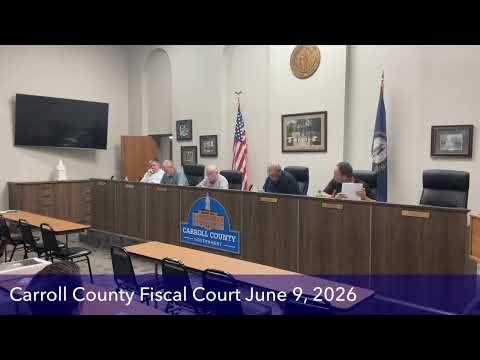
Carroll County Fiscal Court on June 9 introduced and moved to adopt changes to the county's ethics ordinance and voted to overrule petitions to remove two ethics-commission members.
The court read an ordinance described in the record as amending ordinance number 94 16 to create an at-large alternate member of the ethics commission, provide for appointment of special commission members for specific matters, and clarify the county attorney's role as legal adviser. The text presented to commissioners included underline and strikethrough showing the proposed changes, and the county attorney explained the amendment also clarifies that a unanimous vote of members present constitutes commission action.
County Attorney (speaker 4) summarized petitions filed by a local resident, recorded in the transcript as Danny Mayton, seeking removal of two ethics-commission members: Terry Collie and Gwen Abbott. The petitions alleged (1) failure to disclose immediate family employment on financial-disclosure statements, (2) material omission or fraudulent disclosure, (3) conflicts of interest and personal bias, and (4) due-process violations. The county attorney walked the court through the ordinance's removal provision (noted in the record as section 20, subsection c) and the definition of "immediate family," which the attorney said limits disclosure obligations to spouses and unemancipated children residing in the filer's household or dependents claimed for tax purposes.
On the specific allegations, the county attorney said his review of filings and public records did not substantiate some claims in the petition against Abbott: he reported that the business referenced as owned by Abbott's husband appeared in state filings to be owned by a different individual, and he found no evidence of ownership by the constable. The attorney said the commission statutory language does not bar a commission member from serving simply because a spouse holds elected office; a recusal would be expected in a matter directly involving the spouse.
After discussion, a motion to overrule the removal petitions was made and seconded; the court approved the motion by voice vote.
The court also moved forward with the ordinance amendments; the full text was placed on file with the clerk for inspection.
What happens next: the ordinance text is on file for public inspection and the court recorded its ruling to overrule the removal petitions. If the court were to entertain formal removal proceedings at a later date, the ordinance and state law require giving the affected ethics-commission member a public hearing before any removal vote.
Sources: county attorney's summary and the ordinance text provided to the court (as recorded in the meeting transcript).