Get Full Government Meeting Transcripts, Videos, & Alerts Forever!
Get email alerts on the Budget topic
No spam. Unsubscribe anytime.
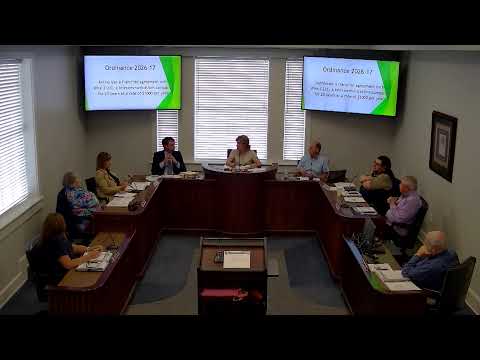
Easley City Council discusses 2026–27 budget, seeks overtime transparency and warns renters will face business-license rules
Summary
At a work session on the second reading of Ordinance 202616, Easly City council members pushed staff for monthly reporting of overtime by department and person, pressed for ward-level estimates of how many residences will be affected by a 6% tax/business-license rule for non-primary properties, and debated personnel-cost pressures that now account for roughly 70% of the general fund.
The Easly City Council discussed the second reading of Ordinance 202616, the city’s annual operating budget for fiscal 2026–27 (July 1, 2026–June 30, 2027), focusing on overtime reporting, a 6% tax treatment of non-primary residences and rising personnel costs.
Council members asked staff to add a monthly line in budget reports showing who requested overtime by department and by person so the council can track overtime requests and better understand recurring personnel costs. A council member said that request was prompted by “a recent situation” and asked the finance office to include the detail in future monthly reports.
Why it matters: council members said transparency on overtime will help the public and the council evaluate personnel costs and whether overtime is being used as expected rather than as a long-term staffing solution. Staff agreed to explore adding the item to the packet and reporting schedule.
Council members also sought clarity about a change discussed earlier in the meeting: second properties (non-primary residences) are assessed at a 6 percent rate and rental properties are considered businesses for licensing purposes. Members asked staff for a ward-level estimate of how many homes will be affected so they can gauge the impact on renters and landlords. City staff emphasized that a primary residence remains on the 4 percent rate; a second property is typically treated as 6 percent and, if rented, should be registered and hold a business license.
The council pressed staff about how the city will determine which properties are rentals (for example, whether door-knock inspections or utility-status checks will be used). Staff described current compliance steps and inspection triggers — including rental inspections after utilities are reconnected — and said they will follow up with detailed counts and options for identifying rental units.
Members also raised a broader budget concern: personnel costs (salaries plus benefits) have tracked near 70 percent of the general fund in recent years. Several members said city employees are the municipality’s primary asset but asked how that share compares with peer cities and whether the high percentage constrains capital spending. Staff said the five-year trend has been near 70 percent and offered to compile comparative data for future discussions.
Other budget items discussed included the placement of several explanatory sections in the budget book versus the operative ordinance language; staff and the clerk explained that changes to the backup materials do not necessarily require an amendment to the ordinance itself, but that council should be clear about which language is binding.
What’s next: council did not take a final vote during the work session. Staff will prepare the requested overtime reporting format and ward-level estimates of affected properties and return with that information as the ordinance proceeds through readings.