Get Full Government Meeting Transcripts, Videos, & Alerts Forever!
Get email alerts on the Middle Housing topic
No spam. Unsubscribe anytime.
Bend planners review state-mandated middle‑housing changes, staff outlines local code updates
Summary
Planning staff reviewed a code package implementing House Bills 2138 and 4037 that will expand middle‑housing options, allow existing homes to count as middle‑housing units, limit traffic analyses for small middle‑housing clusters, and grant bonus units for affordable or accessible units; the commission set a July 13 hearing on related land‑use amendments.
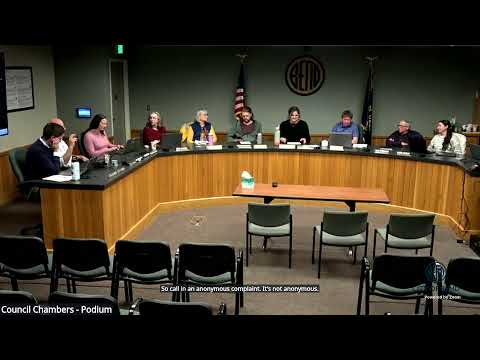
Planning staff presented a package of Development Code and Municipal Code text amendments on June 8 aimed at implementing two recent Oregon bills intended to streamline housing production.
Colleen (staff member) told the Bend Planning Commission the amendments adopt key parts of House Bill 2138 and House Bill 4037 and will appear in proposed changes to the Bend Development Code and Municipal Code. She said HB 2138 allows "existing housing on a lot ... to count towards a unit of middle housing," meaning an existing single‑detached house, a house with an accessory dwelling unit, or a duplex can be treated as one unit in a middle‑housing land division. That change allows a developer to propose, for example, a quadplex adjacent to an existing house and ADU and then use a middle‑housing land division to create separate child lots for each unit.
Staff explained HB 2138 also prohibits traffic impact analyses and certain exactions for townhome or cottage‑cluster middle‑housing developments of 12 units or fewer, and it establishes a "bonus unit" mechanism: duplexes and triplexes may earn one additional unit when including an accessible or affordable unit; townhouses, quadplexes and cottage clusters may earn up to two bonus units. Staff said the code amendments would permit modest increases in development area, floor area, height and density where needed to accommodate those bonus units.
On SROs and parking, staff noted the bills clarify that single‑room occupancies may be detached and that the proposed code establishes maximum parking standards for larger SRO projects.
House Bill 4037 updates were described as placing limits on how much commercial‑zoned land in master‑plan communities may be converted to income‑qualified housing without replacing commercial land: when affordable housing occupies more than 20 percent of commercial land in a master plan area larger than 10 acres, developers must identify replacement commercial areas. Staff also explained HB 4037 narrows notice and appeal rights for clear‑and‑objective housing tracks — notice would go to owners within 100 feet (500 feet for developments of 20 or more units) and public hearings would not be required for these clear‑and‑objective applications; only applicants may appeal those decisions.
Commissioners asked about how CC&Rs (covenants, conditions and restrictions) would be affected; city attorney Elizabeth Oshel said the bills make CC&Rs unenforceable in court if they prohibit ADUs or middle housing after the bills' effective dates. Staff also flagged infrastructure clarifications — sewer and water laterals may be shared subject to public‑works standards; water submetering and administrative arrangements (HOA or similar) may be needed to manage separate billing.
Staff noted the packet includes a draft of many code edits but said the commission will see a more complete packet at the July 13 planning commission hearing; the recommendation to city council is expected Aug. 5 with a second reading later in the summer and an effective date in the fall for parts of the package.
Commissioners did not take action on the package at this meeting but directed staff to proceed to the planning commission hearing on July 13 where the public record will be kept open for the formal quasi‑judicial process.