Get Full Government Meeting Transcripts, Videos, & Alerts Forever!
Get email alerts on the Education Finance topic
No spam. Unsubscribe anytime.
Webster Groves district outlines $5 million operating gap, asks residents to weigh levy vs. cuts
Summary
District staff told a packed forum that Webster Groves faces an estimated $5 million operating deficit for 2026–27 driven by state underfunding, rising health insurance costs and a court ruling that reduced tax revenue; officials asked residents to rank priorities and weigh whether to seek a tax levy or trim services.
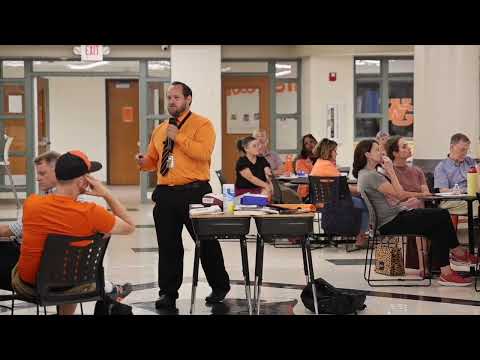
Webster Groves — At a June community forum, Jacob Myers, a district staff presenter, told residents the Webster Groves School District is facing a projected roughly $5 million operating shortfall for fiscal year 2026–27 and asked the community to help choose between asking for more local revenue or cutting programs.
Myers opened his presentation with a visual metaphor: “The backpack here represents our revenue, our budget,” and said the district’s fixed revenue must carry salaries, utilities, curricula and state-mandated obligations. He told attendees the district has been drawing on savings to cover gaps and must decide whether to pursue additional revenue from voters or reduce services.
Why it matters: Myers said about 61% of district revenue comes from local property taxes, roughly 12% from the state through the foundation formula and Prop C, and the remainder from fees and other sources. He said the state’s budget decisions have left districts collectively underfunded by about $345 million; for Webster Groves that translated to an estimated $700,000 hit this year and $1 million–$1.7 million next year depending on final allocations. “We have to be mindful of what that impact is going to be for us,” he said.
Myers emphasized three large drivers of the shortfall: increases in employer health-insurance premiums, reductions in state funding, and a senior property-tax freeze. He said medical premiums have risen steeply since 2022 and cost the district about $1.4 million in higher insurance payments; that, combined with state funding reductions and statutory or court-ordered tax adjustments, has compounded the revenue shortfall.
The presenter traced other structural limits on revenue: Missouri’s Hancock Amendment limits how much revenue a taxing district can collect as property values rise, and the Blankenship court ruling required district tax-rate recalculations that Myers said cost Webster Groves about $2 million a year beginning after the 2010 levy and a cumulative $12 million effect since 2022.
On expenses, Myers said 81% of operating costs are salaries and benefits, while contracted services such as food and transportation account for much of the remainder. He said the district has used attrition and staff reductions where possible — eliminating roughly 15 positions in 2025 and nearly 30 since 2023 — but said most “low-hanging fruit” has been taken and further reductions would be harder and more consequential.
Projected choices and impact: Myers said his “best projection” is that the district would need about a 65-cent operating tax levy to erase the deficit and restore long-term stability; he estimated that would cost a homeowner about $125 a year on a $100,000 home. He also noted a scenario in which, if the district removed the three largest hits (state underfunding, insurance increases, senior freeze), the deficit would shrink to about $1.4 million.
Public process: After the presentation, organizers instructed attendees to work at tables to rank priorities and recommend a preferred pathway — a levy, spending cuts, or a mix — using stickers and group notes. Participants were given 25 minutes for the exercise; staff said they will compile feedback and frequently asked questions, analyze results through June and July, and bring recommendations to the board in August.
Board response: Board President Katie Quinn closed the evening by thanking participants and stressing the board’s responsibility to weigh community perspectives and act in students’ best interests. “Your perspectives and ideas help inform our work,” she said.
What’s next: The district will publish compiled feedback and responses on its One Webster webpage, analyze input over June and July, and present fiscal recommendations to the board in August. No formal vote or levy question was taken at the forum.