Get Full Government Meeting Transcripts, Videos, & Alerts Forever!
Get email alerts on the Snif topic
No spam. Unsubscribe anytime.
Neighborhood impact framework briefed to council: pilots show targeted outreach plus shelter placements reduce repeat encounters
Summary
Neighborhood leaders briefed the committee on the Seattle Neighborhood Impact Framework (SNIF), a coordination model that pairs ambassadors, outreach, intensive case management and prioritized shelter placements; a CID cohort placed in COLEAD shelter saw 95% service connections and a 50% reduction in neighborhood encounters among that group.
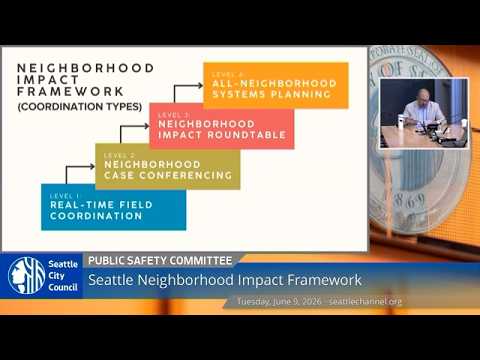
Panelists from neighborhood organizations and partnerships described SNIF as a four-level coordination framework that connects ambassadors, outreach workers, public safety coordinators and intensive case managers to prioritize neighborhood problem spots and individuals with the highest impact on local safety and quality of life.
Sam Wolff, Elena Arakaki, Marcus Johnson, Karen Salinas, Paige Killinger (REACH), and Mike Stewart (Ballard Alliance) said SNIF is not a single program but a platform that allows partners to triage needs, coordinate responses and direct scarce long-term care resources where they will have greatest effect. Panelists emphasized that SNIF complements but does not replace long-term solutions like shelter, housing, and specialized behavioral-health treatment.
Panelists cited a Chinatown-International District (CID) case study: using ambassador encounter data, partners identified a cohort of 41 high-priority individuals for placement into a COLEAD high-support shelter. Panelists reported 95% of that cohort connected to recovery resources and 90% achieved housing-related outcomes; encounters in the CID among that cohort dropped about 50% after placement. Presenters said ambassador teams encountered roughly 1,100 unique individuals last year in CID, and that a small subset (about 5%) comprised a large share of repeat encounters.
Councilmembers asked how "encounter" is defined, how data is used to prioritize limited shelter and services, and how SNIF partners share information with SPD and LEAD while protecting privacy. Panelists described variable encounter definitions across teams, the importance of information-sharing agreements for case conference work, and the need to pair SNIF expansion with more long-term care capacity to replicate CID outcomes across additional neighborhoods.
Committee members and panelists emphasized BIAs and neighborhood leadership as essential implementation partners and said continued funding for coordinators, ambassadors and case management will be required for SNIF to scale. The committee did not take legislative action but indicated interest in further collaboration and potential budget considerations.