Get Full Government Meeting Transcripts, Videos, & Alerts Forever!
Get email alerts on the Utility Scale Solar topic
No spam. Unsubscribe anytime.
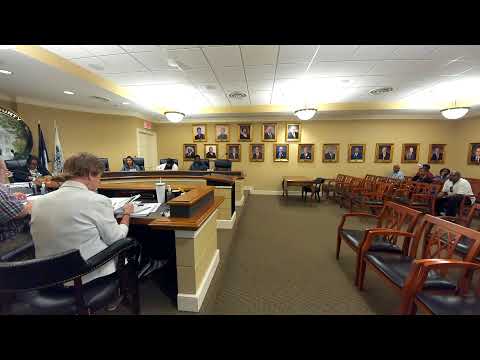
Greensville panel adds comp‑plan policies, acreage cap and site preferences to guide solar projects
Summary
Facing state law changes, the commission amended the comprehensive plan to add policy factors — proximity to transmission, separation between projects and an acreage cap — and recommended preferred siting (brownfields/mined sites) to strengthen local review under the 15.2‑2232 process.
The Greensville County Planning Commission voted to amend the county’s comprehensive plan to add interim policy guidance for reviewing utility‑scale solar and battery storage projects, including recommended siting priorities and a countywide acreage cap as a factor for local review.
Michael Zayner of the Berkeley Group told the commission the comp‑plan appendix will provide evaluation factors that can be applied under the state’s 15.2‑2232 review process when a proposed public‑utility project seeks a determination of consistency with the plan. “This would reinstitute those things as policy factors, by which an application after July 1 you could evaluate for under the 15.2‑2232 review whether or not that project was in accordance with the comprehensive plan,” Zayner said.
Commissioners debated numeric limits and siting priorities at length. One recommendation reinstated a total acreage cap of roughly 6,900 acres already contemplated by earlier planning work so the commission could evaluate future applications against that benchmark. Commissioners also discussed asking that utility‑scale solar, when feasible, be sited on abandoned industrial parcels, brownfields or previously mined lands rather than on prime farmland or forested areas.
Public comments stressed local benefits and fairness. James Taylor urged the commission to require applicants to demonstrate how generated electricity will be used locally, citing a PJM filing by Dominion that could route power to Northern Virginia. “There should be a preference for locally generated power to be utilized locally,” Taylor said.
The commission voted to adopt the comp‑plan amendments and to forward the recommended policies to the Board of Supervisors. Staff and the consultant plan follow‑up work to finalize precise distance measurements, the acreage cap mechanics and the comp‑plan wording that will be used in 15.2‑2232 reviews.