Get Full Government Meeting Transcripts, Videos, & Alerts Forever!
Get email alerts on the Strategic Planning Pillars topic
No spam. Unsubscribe anytime.
Loxahatchee Groves planning board weighs pillars: rural identity, tree protections, public safety and equestrian ideas
Summary
The Planning & Zoning Board discussed defining 'rural' and identified proposed strategic pillars including rural preservation, public safety, infrastructure, and equestrian support; members flagged tree‑removal enforcement, canal water management, and donation policy clarifications as priorities.
Board members at the Town of Loxahatchee Groves spent the meeting working through how to define a 'rural' identity for the town and identifying three to four strategic pillars to guide future action plans.
Cassie Suchi, a board member, proposed a working definition focused on "agricultural residential" uses, low density and open space, and preservation of tree canopy and conservation lands. "We want to prioritize that," she said, urging landscaping rules that require new development to blend into the natural environment rather than remove mature trees and replant in straight lines.
Lisette Vasquez, recently sworn in, said public safety should be a primary pillar and urged restoring police presence tied to the PBSO contract "like, tomorrow," citing neighborhood safety concerns; other members counseled keeping the pillar discussion broad and noting contracting decisions are for the Town Council. Vasquez also raised instances of premature tree removal and asked the committee to consider stronger controls and requiring site‑plan approval before tree removal.
The board also explored equestrian‑focused initiatives as an economic and cultural anchor: members suggested reviving a planned equestrian trail, exploring greenway or state grant funding for trail networks, and considering an overlay or zoning framework that would allow larger, compound‑style equestrian properties to be developed as single units rather than divided into multiple five‑acre parcels.
Town staff and the attorney noted two process constraints: (1) existing code language and interpretations about exceptions for up to four lots (historically tied to 20 acres), and (2) state law (Senate Bill 180) limits on how much a municipality may impose more restrictive standards than current law allows. The attorney emphasized the difference between defining a town vision and changing code provisions; board members said they want clearer criteria from council so the committee can prepare actionable recommendations rather than "a big empty box."
Members also discussed infrastructure priorities such as paving key roads, canal maintenance and a pump‑and‑weir water‑storage system for the north end to aid fire prevention and agriculture, and longer‑term ideas for community events tied to the town's 20th anniversary, noting that donations and fundraising have ordinance and ethics constraints that staff will clarify.
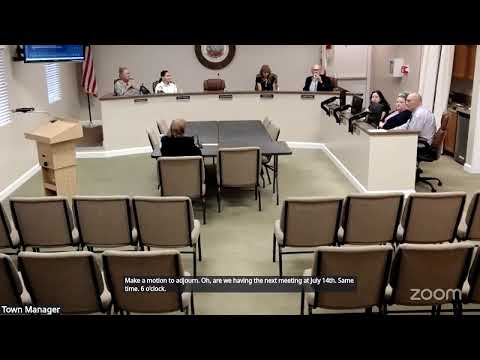
The board agreed to refine the pillars and bring materials and criteria to the next meeting; members were told to send supporting documents to staff if they want them included with the packet. The next meeting was scheduled for July 14, and the temporary chair will present the board—indings to the Town Council on June 16.