Get Full Government Meeting Transcripts, Videos, & Alerts Forever!
Get email alerts on the State Housing Law topic
No spam. Unsubscribe anytime.
Planning staff: new state housing laws will sharply limit local review and narrow notice and appeal rights
Summary
At the June 8 meeting, planning staff told the Oregon City Planning Commission that House Bill 4037 and Senate Bill 974 (effective July 1 and with other operative dates) will narrow public notice areas, convert many housing reviews to staff decisions, and restrict local appeals in most housing cases to the applicant.
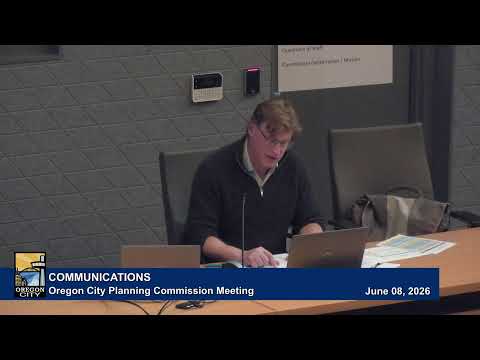
On June 8, planning staff briefed the Oregon City Planning Commission on changes from the 2026 legislative session that will significantly alter how the city reviews housing applications.
Missy Ryan, a planning staff member, told commissioners that House Bill 4037’s Section 17 (effective July 1) amends the state clear-and-objective framework (referenced in discussion as ORS 197A.400) and imposes new limits on procedures, notice and who may appeal. "This takes effect July 1," Ryan said, and she added that the statute tightens notice to property owners within 100 feet of a subject property and raises the notice zone to 500 feet only for developments of 20 units or more.
Ryan said another practical consequence is that many housing-related land-use decisions that previously involved broader local review will now be processed as type-two decisions handled by planning staff. "Only the applicant can file a local appeal of the city's planning staff decision," she told the commission, noting that this will likely prevent neighborhood groups and other third parties from appealing most routine housing approvals locally and will leave applicant appeals and appeals to LUBA as the primary remedies.
The presentation also covered Senate Bill 974, which Ryan said treats certain residential variances, planned-unit developments and zone changes to higher densities in a way that narrows the universe of type-three, discretionary decisions. She warned commissioners that the law also requires waivers of many local design standards in some circumstances (materials, colors, roof and window details), while explicitly protecting life-safety and Goal 5 implementing standards such as historic-resource and greenway protections.
Commissioners asked about public education and outreach; staff said the city maintains a housing-bills page on the city website and that counter staff will direct applicants to it, and that the city will plan further public notifications as needed. Ryan and staff repeatedly cautioned that some provisions are awkwardly worded in statute and will require interpretation and implementation work by city attorneys and staff.
Why it matters: the changes will reduce opportunities for local discretionary review of many housing projects, shrink who receives notice for smaller infill projects and shift more final decisionmaking to staff-level processes. Commissioners were advised the city will monitor how the new rules are applied and return with concrete examples after the laws take effect.
The commission discussed follow-up steps and education; staff recommended returning with practical examples once the new processes are in use.