Get Full Government Meeting Transcripts, Videos, & Alerts Forever!
Get email alerts on the Housing And Development topic
No spam. Unsubscribe anytime.
Board adopts water allocation policy to distribute limited Monterey Peninsula allocation to housing and other categories
Summary
The board approved an administrative water allocation policy for roughly 82 acre‑feet recently allocated by the Monterey Peninsula Water Management District, prioritizing a housing‑growth bucket while reserving portions for waitlisted projects, first‑come uses, and a strategic reserve; staff will monitor usage, time limits and return as allocations are used.
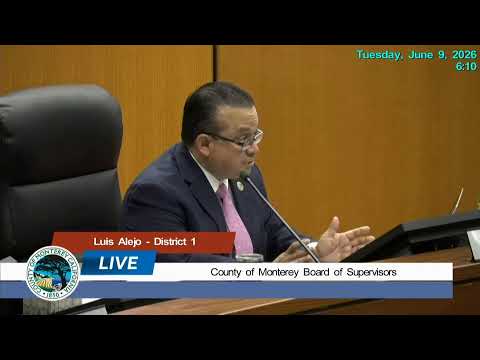
The Monterey County Board of Supervisors voted June 9 to adopt a water allocation policy that sets a framework for distributing about 82 acre‑feet of water the county recently received from the Monterey Peninsula Water Management District. The policy divides the allocation across four categories: existing water‑waitlist projects, planned housing growth, first‑come/first‑served construction permits and a small strategic reserve.
“Staff’s recommendation is administrative in nature” and intended to prioritize water for housing opportunity sites and projects that further the county’s RHNA obligations, Housing and Community Development Director Craig Spencer told the board. Principal planner Sarah Weichel explained the draft table: roughly 19 acre‑feet would be assigned to previously approved waitlist projects, about 52 acre‑feet for planned housing growth subject to qualifying affordability and density criteria, about 9.5 acre‑feet for first‑come/first‑served construction permits and approximately 3 acre‑feet held as a strategic reserve.
Weichel said the policy allows projects to reserve water during completion determination, and sets time limits on how long allocations may be held (generally 2 years for construction permits and up to 5 years for discretionary approvals with limited exceptions for affordable‑housing financing). She emphasized HCD director discretion to elevate some ministerial projects to the planning commission for additional review when thresholds or concerns are triggered.
Public testimony raised concerns that a single large development could use a large share of the planned‑housing bucket; staff noted that many developments’ projected water use would still fit within the proposed allocations and that the policy can be adjusted if usage patterns demand it. The board approved the policy and directed staff to provide transparent tracking of allocations, implement reservation and expiration rules, and to consider modest edits requested during public comment — including options to split the planned‑housing category to ensure ADU/JADU demand is available.
Provenance: Presentation and Q&A on allocation policy (SEG 2923–3070) through board vote adopting the policy (SEG 4467–4472).