Get Full Government Meeting Transcripts, Videos, & Alerts Forever!
Get email alerts on the Meeting Rules topic
No spam. Unsubscribe anytime.
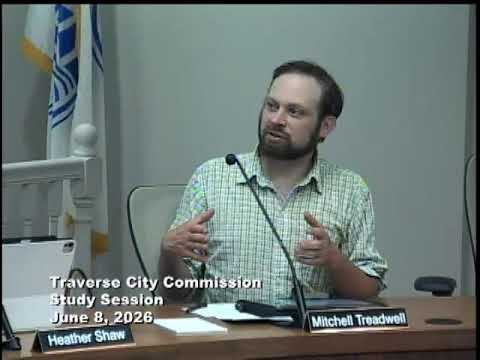
Commissioners debate meeting rules, agenda deadlines and public-comment limits at Traverse City study session
Summary
At a Traverse City study session, commissioners reviewed procedural rules and debated lowering the number of sponsors required to place items on study-session agendas, earlier agenda publication to ease staff workload, and inconsistency between written (five minutes) and practiced (three minutes) public-comment time limits; staff will bring recommendations back for action.
Traverse City commissioners spent a study session reviewing their meeting rules and discussing potential changes to how items get on agendas, when agenda packets are published and how long members of the public may speak.
A staff member opened the discussion by clarifying rules 17–19, noting that public comment at study sessions is taken at the end of the meeting rather than during agenda items and that some procedural rules may be suspended while others (those required by Michigan law) cannot. “I just wanted to clarify that in public,” the staff member said, and emphasized that placing an item on the agenda does not automatically require staff to drop other work to prepare substantive materials.
The group focused on three operational topics: the number of commissioners required to add an item to a study-session agenda (currently three), the deadline for commissioner-submitted agenda items so staff can prepare packet materials, and the packet-publication schedule. Several commissioners urged lowering the study-session sponsorship threshold to two—arguing it encourages collaboration and provides a second pair of eyes—while others defended preserving a commissioner’s ability to bring forward ideas alone without immediate staff commitment.
Commissioners and staff also discussed the timing of packet publication. Members said publishing late on Thursday can create a Monday-night crunch for reviewing materials and formulating questions. Suggestions included publishing earlier in the week, moving agenda-review meetings, and setting a firm deadline for commissioner questions (for example, Friday noon) so staff have time to provide considered responses. The body did not set a new schedule at the study session.
A discrepancy in public-comment practice was raised: rule 17 states public speakers may be limited to five minutes, but commissioners said the customary limit in practice has been three minutes. The inconsistency was noted for future clarification.
Commissioners flagged related operational issues, including overlaps with other commissions’ calendars and large planning commission packet sizes that complicate earlier publication and review. One participant pointed to the city’s strategic plan and cautioned that ideas presented at study sessions can be misread as adopted policy if staff vetting and legal constraints are not clear.
No formal votes or policy changes were made. The commission asked staff and the city manager to return with recommendations and implementation options at a future meeting where the commission can take action. The chair then opened general public comment and closed the study session.
The study session produced a clear next step: staff will draft specific recommendations on sponsorship thresholds, publication timing and public-comment limits for the commission to consider at a meeting where decisions may be made.