Get Full Government Meeting Transcripts, Videos, & Alerts Forever!
Get email alerts on the Land Use topic
No spam. Unsubscribe anytime.
Neighbors raise flooding and wetland concerns as Bloomington planning commission continues 2511 North Dun subdivision
Summary
The Planning Commission continued action on a proposed 11‑lot subdivision at 2511 North Dun Street after hours of public comment about repeated flooding, possible wetland features, and outstanding City of Bloomington Utilities (CBU) reviews. Staff recommended a continuance to July 13 to allow unresolved drainage, easement and environmental questions to be settled.
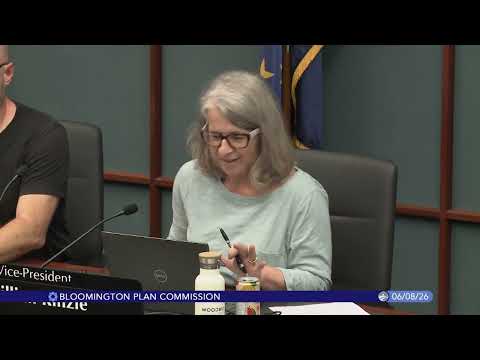
The City of Bloomington Planning Commission on June 8 continued a petition by Paul Puit and Keith Klene for a subdivision of 2511 North Dun Street after residents described repeated flooding, urged a wetland delineation and asked the commission to wait for completed utility and easement reviews.
Jamie Kryler, senior zoning planner, told the commission the property is roughly four acres and that the petitioner is asking for primary plat approval to subdivide the site into 11 residential lots and three common-area lots. Kryler said the petition includes three subdivision waivers: to allow a cul‑de‑sac (hammerhead turnaround), to waive the requirement that 67% of lots be served by alleys, and to amend riparian buffer easement language (UDO §20.04.05010A) to reconcile stormwater maintenance with environmental protections. Kryler noted a prior Board of Zoning Appeals (BZA) decision on variances is under judicial review and that City of Bloomington Utilities (CBU) has given only conditional authorization pending resolution of easement conflicts, tree‑planting locations and acceptable outfall rates. Staff recommended continuing the case to the required second hearing on July 13 to allow outstanding technical review to proceed.
Neighbors urged delay. Attorney Jason McCauley, representing adjacent property owners, said CBU had not finished its review and that easement and sewer issues remain unresolved; he also asked that the commission require a wetland delineation. Longtime residents presented videos and photographs showing recurring water pooling and basement flooding they said originate at or flow through the subject parcel. "This is happening on a regular basis," resident Julie Williams said of flooding that damaged a finished basement; she asked that the commission require more study before decisions that could increase runoff. Several speakers described the rear of the parcel as a seasonal pond or wetland and urged the commission to consider conservation options rather than higher‑density subdivision. A petition circulated by neighbors collected hundreds of signatures opposing the waivers and variances.
Petitioner's explanation and tradeoffs. Consultant Daniel Butler said the revised plan reduces density (from 15 to 11 lots) and that the cul‑de‑sac/hammerhead layout is proposed to preserve more large canopy trees and reduce disturbance. He told commissioners that eliminating a street extension would lower subdivision construction costs by an estimated $400,000 (about $38,000 per lot by the developer's estimate). Butler and staff said the petition has been revised to preserve environmental features and that CBU conditionally finds the approach conceptually workable, though technical easement and outfall details remain open.
Commission discussion and vote. Commissioners focused on the tradeoff between long‑term connectivity (stub streets that can be extended) and protecting tree canopy and riparian features. Staff said the senior environmental planner had assessed the site and did not deem it a mapped wetland; still, staff and the petitioner are proposing riparian buffers and common‑area preservation irrespective of that finding. Given outstanding CBU comments and the pending judicial review of BZA decisions, the commission voted to continue the petition to the required second hearing on July 13 to allow CBU and environmental reviewers time to complete their analyses and to provide the commission with updated findings.
What happens next. The commission recorded a motion to continue and voted in favor (roll call: Bishop, Holmes, Kinsey, Sawberg, Whistler, Burrell). Staff asked that CBU and the city's senior environmental planner attend the July hearing and that the petitioner provide any requested delineation, drainage and easement documents before that meeting.
The case will return to the Planning Commission on July 13 for additional testimony and a fuller staff recommendation once outstanding CBU and environmental reviews are complete.