Get Full Government Meeting Transcripts, Videos, & Alerts Forever!
Get email alerts on the Placemaking topic
No spam. Unsubscribe anytime.
Jennifer Davis outlines streetscape strategies to create "places of memory" in West Hollywood
Summary
Urban planner Jennifer Davis presented examples of memorial parks, sidewalk plaques, billboard-linked plazas and a monarch-focused pollinator plaza as small-scale, people-centered strategies to preserve memory and activate pedestrian space in West Hollywood.
Jennifer Davis, an urban planner who has worked extensively in West Hollywood, argued that dense, fully built-out cities should prioritize small, curated public spaces that preserve memory and foster pedestrian engagement.
"Like diverse colorful beads on a string, it is in the collection of many places for people and how we choose to remember or celebrate our past that defines the beauty and quality of the urban experience today," Davis said, framing her presentation around monuments, markers, sculptures and other streetscape strategies.
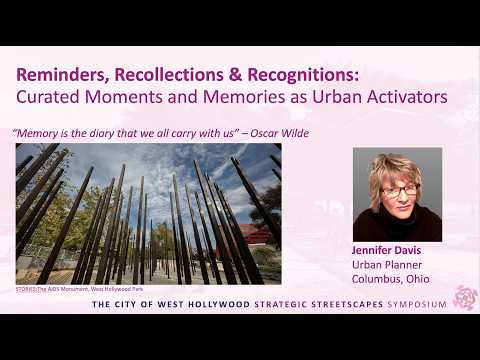
Davis illustrated several local examples. She described the Veterans Memorial at Santa Monica Boulevard and Holloway and the new "Stories" AIDS monument as spaces that combine reflection with storytelling, saying of the latter: "Remember, celebrate, educate." She noted smaller sites such as the Human Rights Triangle and the AIDS Memorial at Hart Park as compact remembrance places that have adapted over time.
She also highlighted embedded sidewalk markers such as the AIDS Memorial Walk plaques on Santa Monica Boulevard and traditional monuments in Plummer Park, describing how these features integrate commemoration into daily pedestrian routes.
Turning to recent West Hollywood projects, Davis explained how the Sunset Arts and Advertising Program encourages public-realm enhancements tied to billboard development. She used the Rainbow Roxy Billboard Project as an example of carving pedestrian space out of billboard property to create a permanent outdoor seating plaza with archival posters celebrating the Sunset Strip's rock-and-roll history.
Davis described a second billboard-led project she called an "immersive and layered" educational plaza focused on the monarch butterfly. That project includes a pollinator garden with seating, illuminated displays of the butterfly's life cycle, terrazzo paving with recycled-glass motifs, dedicated puddling and sunning areas, a green roof planted with host species for caterpillars and a pursuit of wildlife-habitat certification. "This project is even pursuing certification as a wildlife habitat, which I find amazing," she said.
She broadened the talk with international and regional examples of alternative memorial strategies: sculptural works in Prague and Marseille, symbolic artifacts such as the 60 bronze shoes in Budapest that commemorate World War II-era violence, and tiny, discoverable memorials found in London that invite curiosity and local storytelling.
Davis also described Jud Fine's installation "Spine" at the Los Angeles Central Library, emphasizing memorials that are meant to be experienced while moving through them rather than simply observed from a single viewpoint.
Audience reaction was positive: the presentation ended to applause, and the introducer thanked Davis, saying many of the examples were "realizable and achievable" and could be advanced through public-private partnerships and careful design.
The presentation was descriptive and illustrative rather than prescriptive: no formal actions or votes were taken during the session, and Davis framed most proposals as strategies for placemaking, interpretation and ecological support rather than as binding policy decisions.