Get Full Government Meeting Transcripts, Videos, & Alerts Forever!
Get email alerts on the Environmental And Permitting topic
No spam. Unsubscribe anytime.
Developers tell Baltimore County planning staff evaporative cooling, generators and air permits drive data-center impacts
Summary
Oppedin presenters told Baltimore County planning staff that evaporative cooling is the main source of data-center water use, generators are typically diesel or natural gas with routine testing, and air permitting at the state level must model cumulative impacts. They urged transparent permitting and said costly grid upgrades are usually paid by projects.
Pete Carbono and Drew Johnson, developers with Oppedin Investment Company/OPEDN, presented to Baltimore County planning staff and community participants about how data centers are designed, permitted and sited.
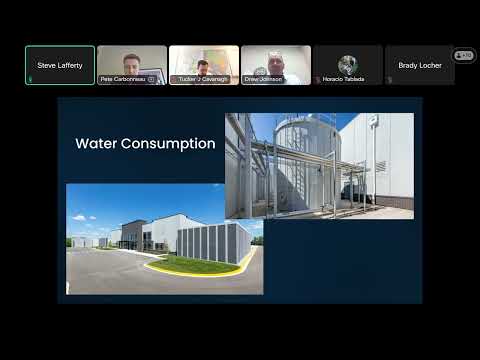
“Most of the larger amounts of water people read about on data centers are consumed through evaporative cooling,” Carbono said, explaining that cooling towers or direct outside-air evaporation are common and that evaporative systems typically use less energy and produce less exterior HVAC noise than mechanical cooling. He said immersive, submersion cooling exists but is not yet used at scale.
The presenters addressed common public concerns about noise and generators. They identified three exterior sound sources—HVAC fans and compressors, backup generators and occasional exterior server-related noise—and said servers are usually enclosed so most sound comes from rooftop equipment and generators. On generators, Drew Johnson said diesel and natural-gas units remain standard because of reliability and operational characteristics; uninterruptible power supplies (UPS) are used for instantaneous backup but large batteries for hours-long outages are uncommon.
On air quality and permitting, presenters said Maryland requires a permit to construct and a permit to operate for generator and related emissions, and that Title V federal permits apply only to much larger sources. An attendee noted recent reporting on cumulative effects; presenters and other participants said Maryland’s permitting now must consider cumulative impacts in environmental-justice areas and that modeling and public comment are part of the state process.
Water and utility interconnection questions drew technical answers. Carbono and Johnson said the apparent tradeoff—more water use for evaporative cooling versus higher energy use and exterior equipment for mechanical cooling—should be weighed alongside local water-appropriation rules. They also explained that transmission and distribution upgrades (transformer work, substation expansions, new breakers) required for large data-center loads are typically paid for by the project, while some utilities are creating special large-load tariffs that allocate costs differently.
Both presenters emphasized that community engagement and transparency often mean making applications public and holding community meetings once projects are formalized; they noted that NDAs can complicate early-stage disclosure. They offered to share their slides with the county planning team for public posting and said they were available for follow-up questions.
The session closed with presenters reiterating that air permitting and modeling will be handled through Maryland’s processes and that project-specific details (exact noise modeling, generator hour limits, and any needed water appropriations) are determined during permitting and engineering review.