Get Full Government Meeting Transcripts, Videos, & Alerts Forever!
Get email alerts on the Budget And Taxes topic
No spam. Unsubscribe anytime.
Board of Finance approves 2.48% tax increase, sets mill rate at 16.967; adopts $5.8M drawdown
Summary
The New Canaan Board of Finance voted June 9 to set the amount to be raised by taxation at $168,118,990 and a mill rate of 16.967 (a 2.48% increase), approving a $5.8 million planned drawdown of the unassigned general fund; the board also approved four year-end transfers totaling $48,647.81.
The New Canaan Board of Finance voted June 9 to set the amount to be raised by taxation at $168,118,990 and established a mill rate of 16.967, representing a 2.48% increase. The board approved a revised planned drawdown of $5.8 million from the unassigned general fund as part of that action.
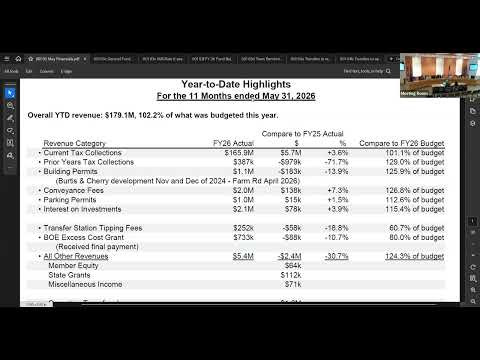
The vote followed a staff presentation of year-to-date finances and projections. Ryan reported that year-to-date revenue through the end of May totaled $179.1 million, about 102.2% of the fiscal-year budget, and that current tax collections were $165.9 million (roughly 101.1% of budget). Ryan said conveyance fees and interest income materially exceeded budgeted expectations, with building permits and conveyance activity contributing to a stronger-than-expected revenue picture.
Those revenue beats, combined with expenses projected to be under budget, produced a larger-than-expected fund balance and opened a choice for the board: return a portion of surplus to taxpayers by lowering this year’s mill-rate impact, or preserve more of the unassigned fund balance as a cushion against future revenue or expense shocks. Staff outlined two primary options: maintain a $5.0 million drawdown or increase the budgeted drawdown to $5.8 million, which would yield the 16.967 mill rate and a 2.48% increase in taxation.
Members debated the tradeoffs. Some argued the town should give back excess revenue to taxpayers in an inflationary environment; others urged caution, noting potential volatility in conveyance fees and interest income and the longer-term capital pressures from rising school enrollment. One board member framed the larger drawdown as a possible “drug” that could set a higher base next year if used repeatedly; others said the $5.8 million figure reflected a prudent middle ground given this year’s one-time revenue beats.
After discussion the board made a motion to set the tax levy at the figure presented and to adopt the 16.967 mill rate. The motion was seconded by Michael Chan. By show of hands the motion carried; the chair declared the motion adopted.
Votes at a glance - Mill-rate motion: approved (amount to be raised by taxation $168,118,990; mill rate 16.967; 2.48% increase). Motion carried by voice/show of hands; no opposition recorded in the transcript. Mover not specified in the record; second: Michael Chan. - Year-end line-item transfers: approved. The board approved four transfers totaling $48,647.81 (a $9,000 contingency transfer to tax collector postage; $7,500 from salary contingency to police education salaries for contract retroactive pay; internal BOE line adjustments including a stop-loss/administration fee reallocation; and $20,352.67 from contingency to health and welfare to cover private-school healthcare reimbursements). The transfers passed with one member recorded as opposed.
Context and next steps Staff reported an estimated unassigned fund balance of roughly $25.17 million at the end of FY26 under current projections and said encumbrances remain open for 60 days, which could affect final expenditure totals. The board directed staff to continue monthly monitoring and to return with any material changes; no additional formal actions were scheduled at the meeting. The board also noted its intention to highlight in communications that New Canaan’s projected expense growth compares favorably with peer towns.
Authority and clarifications The transcript references a state statute in the context of reimbursements to private schools for health-care costs; the board relied on staff’s interpretation during the approval of the health-and-welfare transfer. Where the transcript is not explicit (for example, the member who formally moved the mill-rate motion is not named), the article notes that the mover is not specified in the record.
The board adjourned following routine administrative approvals.