Get Full Government Meeting Transcripts, Videos, & Alerts Forever!
Get email alerts on the Budget And Operations topic
No spam. Unsubscribe anytime.
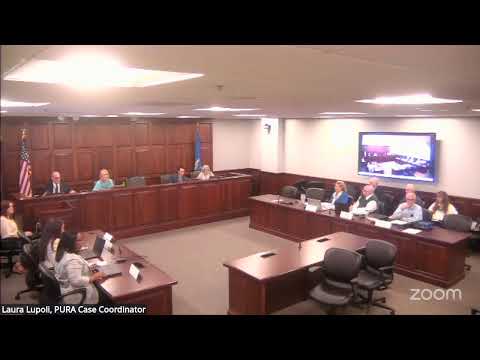
PURA hearing probes Nutmeg’s operating plan, budget projections and regional-branch model
Summary
During cross-examination, counsel pressed Nutmeg on the timing and detail of its operating-plan filings, whether the budget realistically reflects rent, utilities and professional services for an unlocated regional branch, and how subscriber funds would be allocated to local services.
Company counsel spent much of the hearing cross-examining Nutmeg witnesses about specifics of the group’s operating plan and financial projections.
Attorney David Boen pressed Nutmeg on when it filed its vision statement and operating plan, noting discrepancies between March and April filings and asking witness Joanie Wedler to identify when the operating plan, budgets and supporting documents were submitted into the record. Wedler acknowledged a March vision statement and supplemental filings in late March/April but accepted counsel’s request to have panelists confirm dates with the record.
Counsel also focused on Nutmeg’s projected single regional TV branch: witnesses said the plan assumes one southwestern Connecticut regional branch (Farmington would remain Nutmeg’s central office) and that the operating budget does not include a fully identified site. “We have not identified a location nor have we begun that work,” Wedler said; she said projected rent was modeled on current Farmington costs and would be refined after site selection.
Budget line items drew repeated requests. Counsel asked for backup showing how Nutmeg derived projected 2027–2029 professional-services costs (appendix B), rent and utility assumptions, and the “light green” line shown on the budget overview. The commission ordered Nutmeg to provide late-filed exhibits with the requested detail.
Nutmeg described its revenue mix as subscriber PEG fees, grant funding (including PegPedia awards), fundraising via a conversion service that digitizes tapes and slides, and occasional studio rentals to commercial or nonprofit clients when the facility is not in use by the public. Witnesses said conversion orders average roughly 50–100 orders per year and that a $250,000 CD from the sale of Nutmeg’s building provides a small reserve. Nutmeg said capital expenditures are often funded with grant awards rather than subscriber revenues.
Commissioners repeatedly asked how Nutmeg would ensure subscriber funds collected in a given franchise footprint would be applied to services for that footprint once operations were consolidated. Nutmeg’s witnesses described a “localized funding model” in which subscriber revenue would be allocated to regional branches that serve the paying franchise areas, but several commissioners requested a written allocation policy and more detail on how local channel capacity and scheduling would be preserved when multiple areas share a single public-access channel.
No final determinations were made. The authority requested late-filed exhibits documenting budget backup, professional-services detail, audited financial statements (P&L and balance sheet for 2025), and the localized funding-allocation policy for regional branches.