Get Full Government Meeting Transcripts, Videos, & Alerts Forever!
Get email alerts on the Bond And Facilities Plan topic
No spam. Unsubscribe anytime.
Greater Albany Public SD 8J committee advances long-range facilities priorities ahead of $168 million bond push
Summary
Committee members reviewed test-fit designs for multiple campuses, debated consolidation triggers and timing, and instructed staff to finalize priority packages for polling and a November board vote; staff flagged a Dec. 1 state submission deadline and a potential $8 million grant tied to passing a bond.
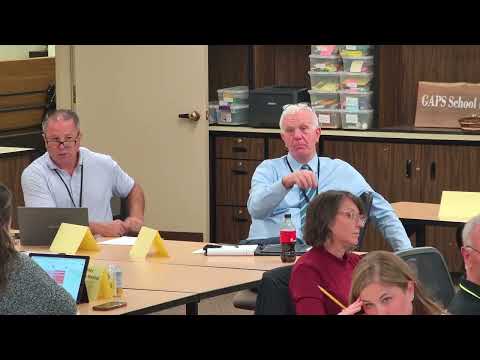
The Greater Albany Public SD 8J long-range facility planning committee met to refine priorities for a proposed bond package, weigh school consolidation options and review test-fit designs for Tina, West Albany and South Albany.
Moderator opened the meeting by telling the group that "the work tonight will be largely focused on the long range plan," and staff walked members through the schedule and next steps, noting the board is expected to vote in November so the district can meet the state Department of Education submission deadline on Dec. 1 and pursue a potential $8 million grant if the bond passes.
Why it matters: Committee members must balance capital needs across elementary, middle and high schools while keeping the bond electable. Staff summarized a $168 million target for the bond and said updated assessed-value forecasts later this year could change revenue assumptions.
Designs, priorities and trade-offs: Staff recapped recent workshops and test-fit work. For elementary planning, the Tina site plan was revised to accommodate special-education classrooms and a behavioral-health room; staff said modulars currently on the site would be removed and buses could be routed into a dedicated drop-off. At the high-school level, two schemes for South Albany were shown (options A and B); staff noted the options split committee preference and used the lower-cost option as a planning reference. For West Albany the group discussed a phased approach that preserves Career and Technical Education (CTE) shops while reducing square footage devoted to athletic additions in earlier phases.
Consolidation triggers and timing: Staff recommended distinguishing three work streams—long-range facility planning, building-capacity review and administrative policy recommendations—and proposed annual capacity reviews to prevent rushed consolidation decisions. Andy (staff) said the committee "would ask that you guys consider a proposal that they be looked at annually," framing triggers as board-level decisions informed by this committee rather than an immediate mandate.
Costs and savings: Staff walked through revised worksheets that convert priority votes into base costs and showed examples of recoverable savings if schools close: closing "central" was estimated to recover roughly $4.0–$4.3 million; closing another site (referred to as "Maze" in the discussion) was estimated at about $2.2 million. Staff cautioned that some mechanical and envelope work may still be required depending on timing and any reuse or lease arrangements.
Reuse and community partners: The Albany Historical/Regional Museum board told staff it would be interested in relocating to Central if the district made the building available; staff said lease terms (for example, triple-net) would need negotiation and could affect decisions on whether to mothball or preserve an asset.
Equity and messaging concerns: Multiple table reports raised a recurring concern that earlier exercises had weighted high-school investment more heavily than elementary work. Members emphasized the need for clearer public messaging about why investment levels vary by campus. Committee members and staff repeatedly referenced electability concerns; JL summarized the outreach strategy succinctly, saying the campaign should "lead with no tax increase."
Next steps: Tables will finalize high/medium/low priority worksheets for staff to synthesize, staff will pull updated assessed-value and revenue information later this year, and the group will reconvene in September to finalize recommendations to the board. The committee will use targeted polling to test community support and refine package messaging ahead of a potential November board vote.
The committee did not take any formal votes during this meeting; members asked staff to return more refined cost packages and to build a public outreach plan that foregrounds revenue assumptions, timing for potential closures and the district's stated goal of not raising the levy rate.