Get Full Government Meeting Transcripts, Videos, & Alerts Forever!
Get email alerts on the Parking Regulations topic
No spam. Unsubscribe anytime.
Deltona commission directs staff to study roadway-width, fire-safety and service-vehicle parking rules
Summary
At a June 8 workshop, Deltona commissioners heard a consultant say there were just over 6,000 documented crashes (2021–2025) and asked staff to return with draft parking rules tying on-street allowances to roadway width and design speed, clearer service-vehicle exceptions, and enforcement options including contracted towing.
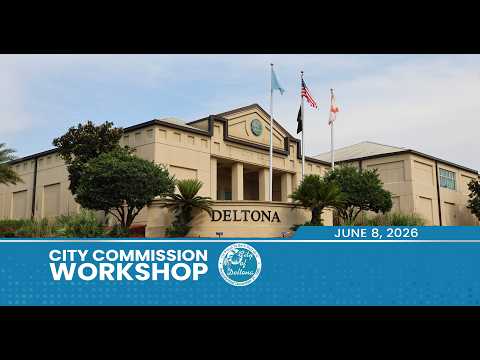
At a June 8 Deltona City Commission workshop, a consultant presented an updated five-year crash review and commissioners directed staff to return with draft parking rules that would link on-street parking to roadway width and design speed, tighten rules for vehicles that pose fire risks, and create clearer exceptions for service vehicles.
Edward of the Cordino Group told the commission the firm had expanded its crash review to cover Jan. 1, 2021–Dec. 31, 2025 and found "a total of just over 6,000 documented crashes," with about 100 on-street incidents mapped for detailed analysis. He said parked vehicles can create restricted sight distance and that narrower, newer subdivisions can raise maneuverability concerns for emergency apparatus. "One recommendation is having no on-street parking on roads with a design speed over 35 miles per hour," Edward said.
The presentation emphasized emergency access standards used by the fire department and engineering guidance for lane widths. Consultants and staff noted that fire apparatus needs roughly 20 feet of unobstructed space to deploy equipment; the Cordino Group also cited Firewise/NFPA defensible-space guidance in discussing a 30-foot separation recommendation for some large recreational vehicles and boats, while acknowledging that the 30-foot measure is a guideline rather than a local code requirement.
Several commissioners urged care in implementation, saying large parts of Deltona's existing neighborhoods lack rear-yard or side-yard space to meet large setbacks. Vice Mayor Villa Vasquez said, "We're going to have a problem because our current homes are not going to measure the 30 ft," and urged options such as grace periods or off-site storage rather than immediate, citywide setbacks.
A number of enforcement and operational options surfaced during the discussion. One commissioner proposed issuing an RFP for contracted towing to clear blocked streets and preserve access for trash pickup and emergency vehicles, describing a model in which a contracted tow operator would remove vehicles from designated sides of narrow subdivision streets during enforcement windows. Staff cautioned that enforcement would be difficult while the existing suspension of enforcement remains in place but said a codified ordinance would enable stronger action.
Consultants recommended several near-term, lower-impact steps: restricting parking on interior curves, establishing intersection setback distances (about 100 feet), clarifying minimum driveway clearances (5–10 feet), and creating explicit exceptions to allow service vehicles to park on-street while actively servicing a property if an operator remains on site and can move the vehicle quickly.
Speakers also discussed neighborhood-level solutions. The Cordino Group suggested programs to convert swales or provide stabilized, permeable parking surfaces through either city-assisted projects or neighborhood-led MSTU-style financing. Commissioners emphasized that any swale conversion must protect drainage and noted maintenance and long-term costs could fall to the city unless acceptance of maintenance is clarified via permitting.
During a series of hand/roll-call votes, the commission asked staff to continue developing a roadway-width/design-speed approach (option one), declined to pursue curvature-only regulation (option two), expressed mixed support for lot-size/30-foot separation rules while asking staff to pursue debris-and-flammable-hazard clearance standards, rejected a private-swale conversion option after a tied vote, and asked staff to draft clear service-vehicle exception language for active service calls. No ordinance was adopted at the workshop.
Public commenters urged compromise and more education before strict enforcement. One resident asked the commission to allow partial swale parking or covered parking in specific circumstances; another warned that heavy trucks and repeated swale parking damage drainage infrastructure and urged prompt code enforcement.
Next steps: staff will return with draft ordinance language and implementation options that reflect the commission's direction on roadway-width standards, service-vehicle exceptions and enforcement alternatives, including the possibility of a contracted towing program and gradual implementation measures such as amnesty or phased compliance periods.