Get Full Government Meeting Transcripts, Videos, & Alerts Forever!
Get email alerts on the Administrative Rulemaking topic
No spam. Unsubscribe anytime.
House approves package to increase legislative oversight of administrative rules
Summary
Lawmakers passed a set of bills (HB5815–HB5818) intended to shift rulemaking oversight toward the Legislature, require cost-benefit analysis, and create a new joint committee (ROAR). Sponsors said the measures restore separation of powers; each bill passed on a roll-call vote.
The Michigan House approved a multi-bill package that changes the state's administrative rulemaking process, strengthens legislative oversight, and requires additional agency analysis for significant rules.
Representative Waznjak, speaking on behalf of the package, said the bills "reaffirm a simple principle: laws should be written by elected lawmakers, interpreted by courts, and faithfully administered by executive agencies." He described provisions that would give the Legislature greater review authority and require courts to exercise independent judgment rather than deferring to agencies’ interpretations.
Representative Aragona said the legislation addresses what supporters described as a lack of true oversight and would create a new joint committee — Regulatory Oversight and Administrative Review (ROAR) — to replace the current Joint Committee on Administrative Rules (JCAR). Supporters said the bill set would require meaningful cost-benefit analyses and a five-year review process for existing regulations.
Representative Shudy also praised the package as a long-overdue overhaul of Michigan’s rulemaking system, saying the changes aim to protect workers, families, and job providers from what sponsors called "overreach."
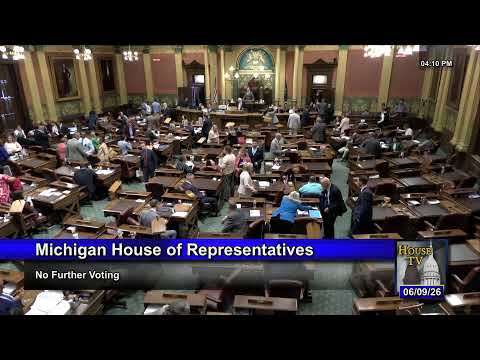
Each bill was taken up on third reading and subjected to a recorded roll-call vote. The clerk announced the following results: HB5815 passed 58–46; HB5816 passed 58–46; HB5817 passed 57–47; HB5818 passed 57–47. After passage, the majority moved for immediate effect on each measure and that motion was ordered.
Sponsors described the changes as restoring legislative checks and balancing agency power, while opponents — reflected in recorded 'nay' votes — signaled concern about shifting authority from agencies to lawmakers.
The bills now proceed toward enrollment and any subsequent enrollment/resolution steps required before becoming law.