Get Full Government Meeting Transcripts, Videos, & Alerts Forever!
Get email alerts on the Program Overview topic
No spam. Unsubscribe anytime.
Library of Congress highlights 'By the People' volunteer transcription program and its impact
Summary
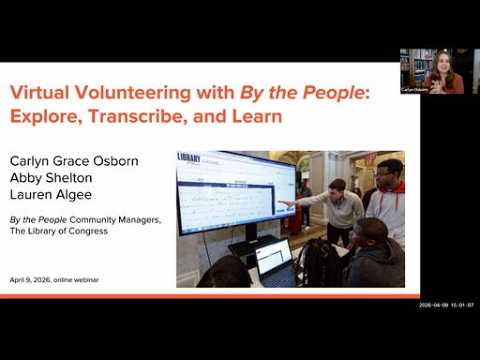
Library of Congress community managers presented By the People, the Library's crowdsourced transcription program, noting volunteers have transcribed over 1.2 million pages across 53 campaigns and that adding transcriptions has doubled web traffic to sample collections.
The Library of Congress showcased its volunteer transcription program, By the People, during a public webinar, emphasizing the program's role in improving access to historical collections and supporting research. Carlyn Grace Osborn, a By the People community manager, led the presentation and said the program connects volunteers with manuscript materials while improving discovery on loc.gov.
"By the People is a virtual volunteering program entirely online at Crowd loc.gov," Osborn said in the opening presentation, explaining that volunteers transcribe handwritten and typed historical documents and review others' work before publication. She described review as a "safety net" that helps ensure completed transcriptions are accurate before they appear on the Library's main website.
Osborn and her colleagues provided program metrics to illustrate impact. Abby Shelton, another community manager, said the program has produced more than 1.2 million transcribed pages across 53 campaigns since its 2018 launch and that over 770,000 transcriptions have been returned to the Library's main digital collections. Shelton added the program has more than 53,000 registered volunteers.
Shelton also cited internal web analytics showing that adding volunteer transcriptions increases public engagement with collections: in one example the transcribed portion of the Clara Barton collection saw web traffic double, and she said approximately "30 to 40% of the search terms that people use" to reach collections only exist in transcriptions.
Program staff emphasized practical benefits: transcriptions make handwritten, blurred or dense materials keyword-searchable, improve accessibility for screen readers, and create machine-readable text useful for computational research. As a light example of improved discovery, presenters showed Rosa Parks' recipe for feather-light pancakes, noting that once transcribed the item becomes discoverable by searches for specific ingredients like peanut butter.
The webinar closed with a reminder that By the People content and tools are available at crowd.loc.gov and that the Library will publish the presentation recording and slides for attendees. Osborn encouraged attendees to register at the site to track contributions and, if interested, to consider serving as reviewers to help finish campaigns so collections may be published back to loc.gov.