Get Full Government Meeting Transcripts, Videos, & Alerts Forever!
Get email alerts on the Telecom Infrastructure topic
No spam. Unsubscribe anytime.
Residents successfully oppose pair of inline-amplifier shelters; board denies petition
Summary
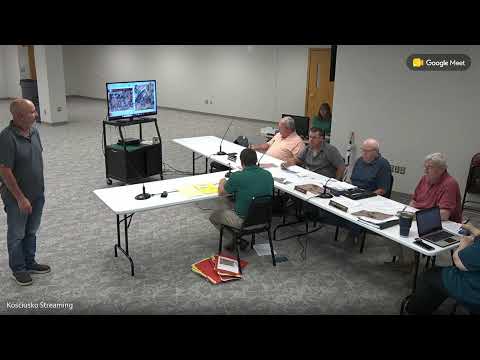
Residents objected to two proposed fenced inline-amplifier (ILA) shelters sited in a rural area, citing noise, lighting, wildlife and property-value concerns; after public comment the Kosciusko board voted to deny the petition for the unmanned fiber relay shelters.
Kosciusko County rejected a petition to place two inline-amplifier (ILA) utility shelters on a rural parcel after an extended public comment period in which nearby homeowners described the proposed 32-foot shelter structures as visually intrusive and raised concerns about generator noise, lighting, wildlife impacts and perceived health effects.
The petitioner’s representative (identified in the record as Gina Dalton with 'Telomon') said the unmanned facilities would be low profile, fenced, screened and intended to amplify fiber-optic signals to improve redundancy and service for residential, commercial and emergency communications. She said the shelters do not require water or sewer and would generate minimal traffic after construction.
Multiple nearby residents, led by Tina Pence, objected to the location. Speakers described the proposed buildings as ‘monstrous’ and raised concerns about continuous humming from backup generators and batteries, exterior lighting, impacts on sandhill cranes and eagles, and potential interference with implanted cardiac devices. Several speakers worried about long-term impacts on property values and the prospect of additional industrialization on the larger parcel.
The petitioner responded to technical questions—stating the proposed power service as 800-amp, three-phase—and reiterated that the shelters would be unmanned and minimally lit. After discussion the board made a motion to deny the petition; the motion passed.
Board minutes and the hearing record show strong resident opposition shaped the decision; staff and the petitioner may pursue alternative sites or additional mitigation but the transcript records the board vote to deny this siting proposal.