Get Full Government Meeting Transcripts, Videos, & Alerts Forever!
Get email alerts on the Zoning Bylaws topic
No spam. Unsubscribe anytime.
Orleans planning board advances modernized use table, readies bylaw updates
Summary
The Orleans Planning Board reviewed a recertified zoning bylaw and a draft, consolidated use table meant to replace roughly 100 line items with broader commercial categories, and outlined hearings and technical edits to align bylaws with Massachusetts General Laws.
The Orleans Planning Board on June 23 reviewed a recertified zoning bylaw and a proposed, streamlined use table designed to modernize how commercial activity is categorized in town.
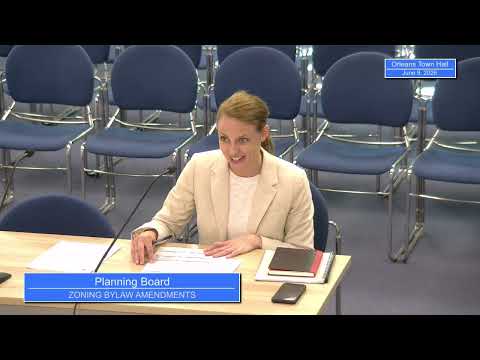
Elizabeth Jenkins, assistant director of planning and community development, distributed the recertified zoning bylaw and described "phase two" technical updates: small legal and definitional changes required to align local language with Massachusetts General Laws and to address recent accessory dwelling unit revisions. Jenkins said those changes are intended to be non-substantive clarifications rather than policy shifts.
Jenkins also presented a draft of a modernized use table that consolidates many antiquated, highly specific entries into broader categories such as food and beverage services, offices, retail sales and personal and community uses. "In terms of the commercial uses, we have consolidated numbers of uses into categories," Jenkins said, adding that the new table had been pared down from roughly 100 entries to a single page in the circulated draft.
Board members discussed keeping certain unique, local uses called out — for example marinas and boat-related services tied to Orleans's waterfront economy — while generalizing more common uses to reduce regulatory complexity. Jenkins said regulated categories such as marijuana operations and utilities must remain explicit. Members stressed balancing simplification with protections for downtown walkability and place-making.
The board debated the prevalence of special permits, with members urging caution about over-reliance on special-permit triggers that routinely push projects to the Zoning Board of Appeals. One member said special permits can be overturned on appeal and recommended a conservative approach to where those triggers remain.
The board also directed staff to prepare related tables, including a parking table aligned with the revised use table and shared-parking approaches used in the overlay district. Jenkins said she will circulate a parking-table draft at the next meeting.
On schedule, staff noted town meeting is set for Nov. 16, the warrant will open in late August and stay open through September, and that the planning board will need public hearings in July/August to meet that calendar. Jenkins proposed a joint meeting with the Zoning Board of Appeals and ARC in July or August, depending on the ZBA's schedule. She also reported work is underway on a Growth Incentive Zone application and that an intern — a UNC master's student — will start Monday to assist with research for that effort.
The board did not vote on any bylaw amendments at the meeting; members asked staff to continue refining language and circulate drafts for public feedback ahead of formal hearings.