Get Full Government Meeting Transcripts, Videos, & Alerts Forever!
Get email alerts on the Land Use Development topic
No spam. Unsubscribe anytime.
Corte Madera planning commission recommends approval of 150‑unit senior care community at 56 Madera Boulevard
Summary
The Planning Commission voted 4‑0 June 6 to recommend that the Town Council approve a 150‑unit residential care facility for the elderly at 56 Madera Boulevard. Staff cited SB 330 limits, a negotiated $1.9 million in‑lieu fee and environmental consistency under CEQA §15183; neighbors raised concerns about tree removal, night‑heron roosts and pedestrian safety.
The Corte Madera Planning Commission voted unanimously June 6 to recommend that the Town Council approve a 150‑unit Residential Care Facility for the Elderly (RCFE) at 56 Madera Boulevard, after staff and applicant presentations and a public comment period that centered on trees, pond habitat, parking and pedestrian safety.
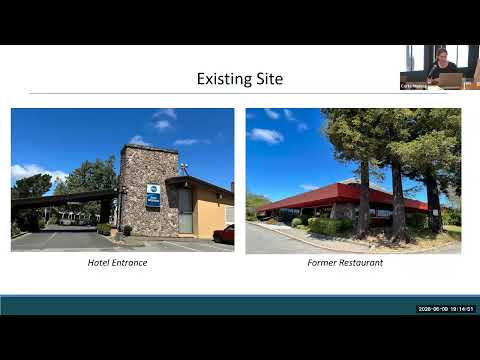
Staff summarized the project and the legal framework that governs its review. "This is an SB 330 application," Community Development Director Amy Lyle told commissioners, adding that the law "really limits the ability to have any subjective standards" and requires objective review of the project's compliance. The development, presented by ONI Development on behalf of Oakmont Management Group, proposes 118 assisted‑living units and 32 memory‑care studios in a roughly 176,500‑square‑foot building with two‑ and three‑story sections. The applicant seeks several waivers, including increases to floor‑area ratio and building height (project peaks near 44.4 feet), and adjustments to parking and bicycle‑parking requirements.
Staff and the applicant explained changes made since an October study session. The applicant pledged to preserve five redwoods along the freeway, increase planted trees from 171 to 350, add landscaping along Tamil Vista Boulevard and underground four overhead utility poles. Project materials estimated the site will provide 98 parking spaces, including eight EV chargers and four accessible spaces; staff contrasted that number with alternative calculations that could require as many as 192–210 spaces under other standards.
A central point of debate was affordable housing. The developer removed earlier proposed on‑site affordable units, saying the RCFE operational and care model prevents delivering conventional inclusionary units. Staff said negotiations produced a commercial‑linkage in‑lieu payment of roughly $1.9 million that would go to the town’s affordable housing fund to support off‑site housing programs. Strategic Economics had recommended a theoretical maximum fee in analysis materials, but staff said that adopted fees are typically set well below theoretical maxima; at hearing staff quoted the negotiated rate in different terms in the packet and discussion.
Environmental and habitat concerns were raised by neighbors and the Marin Audubon Society. The site contains a 0.81‑acre pond with a winter roost used by black‑crowned night herons. Project biologist Sarah Lynch (Monkin Associates) told commissioners the birds use the site as a roost but do not nest there; she said construction noise will likely displace roosting birds during work, but the project includes invasive‑species removal, pond cleanup and stormwater bio‑retention that, over time, should improve habitat quality. The project team said it has coordinated with the Army Corps of Engineers, the Regional Water Quality Control Board and the California Department of Fish and Wildlife and purchased mitigation credits at a 2:1 ratio from a mitigation bank to meet regulatory requirements for outfall modifications.
Several residents urged the commission to require better screening and lighting controls to limit headlight glare into adjacent neighborhoods and pressed for pedestrian safety improvements at the Madera Boulevard/Tamill Vista crossing. "There needs to be the little buttons that we press," said Pamela Zerby, noting near‑misses at the crossing. Staff said public works will review potential safety upgrades, such as pedestrian beacons, as part of ongoing traffic and capital planning.
On CEQA, consulting firm GHD reviewed the project and staff recommended a finding that, under CEQA Guidelines §15183, the project is exempt from further environmental review because it is consistent with the general plan density and adopted programmatic documents. Staff included that recommendation in Draft Resolution 26‑007, which the commission approved to send to council as its formal recommendation. The motion was approved on a 4‑0 roll call (Commissioners Bandell and Rogers, Vice Chair Kenny and Chair Chase all voted yes).
Next steps: the commission’s recommendation and project materials will go to the Town Council for final decision; staff noted a July 7 council meeting as the target if the applicant’s schedule and paperwork remain on track.
The staff report and attachments included an arborist inventory, comparative parking analyses and the GHD CEQA memorandum. The record shows the town and applicant negotiated design and mitigation measures during the entitlement process; neighbors and the Marin Audubon Society asked for clearer commitments on roosting habitat, local mitigation benefits and patrolable public access to pond views, while staff and the applicant described the pond as private property with ongoing agency permitting obligations.
The commission’s recommendation does not itself authorize construction. Any council action will be the final local decision and could include further conditions. The commission directed staff to continue refining landscape screening, ensure downward‑directed, night‑sky‑compliant lighting, and work with public works to evaluate pedestrian safety measures at the nearby crossing.