Get Full Government Meeting Transcripts, Videos, & Alerts Forever!
Get email alerts on the Flood Response topic
No spam. Unsubscribe anytime.
Corte Madera flood board updates response plans, residents press for berm and interim measures; ad hoc preparedness subcommittee formed
Summary
Town staff outlined short- and long-term work after the Jan. 3, 2026 flood — communications planning, education materials, sandbag stockpiles and a $500,000 corpyard repair — while residents urged both a $190 million full berm and interim barriers. The board agreed to create an ad hoc subcommittee to help plan a fall flood-preparedness fair and guide outreach and interim preparedness steps.
Corte Madera town staff on Thursday reviewed the town's response to the Jan. 3, 2026 flooding and outlined near-term and long-term preparations while residents urged both immediate protections and a large-scale berm project.
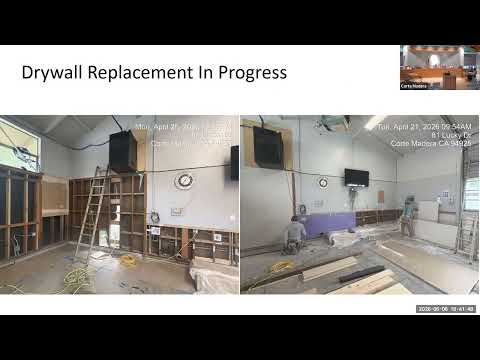
The staff presentation described a short-term package that includes a finalized communications playbook for emergencies, outreach and educational materials and a plan to restock sandbags and other emergency supplies at the Paradise Drive facility. Staff also described ongoing work to repair and raise outlets at a town corpyard, which they estimated as roughly a "half a million dollar" project to replace damaged appliances, raise electrical outlets and finish mitigation work.
Why it matters: The town is balancing immediate, low-cost preparedness actions ahead of the fall king tides with planning for multi-million-dollar infrastructure projects to protect neighborhoods such as Marina Village and Mariner Cove. Funding is not secured for the larger berm or levy projects; staff said survey and design work will start once consultants and grant opportunities are identified.
Resident Roy Wolfford, who self-identified during the public comment period, urged a dual approach: a long-term, comprehensive berm and interim property-level measures. "If it cost us $190 million," he said, "that approach to doing a full berm and doing it as fast as possible ... I don't get a sense that a majority of the council members are on board." Wolfford also described lower-cost interim options he has researched, including masonry surrounds with removable planks and water-filled barriers known as "guppy" tubes to protect individual homes.
Town staff responded that many of the temporary measures are feasible but come with logistical limitations. "Once we get the survey data back ... we would work with homeowners individually," staff said, explaining that parts of the berm lie on private property and the town must obtain homeowner permission before placing sandbags or other materials on private land. Staff estimated the immediate focus will be about four houses on Harbor and two or three on Channel Drive as the worst spots to shore up before high tides.
The board also discussed FEMA recommendations for raising homes and the rule that elevated homes typically must include flood vents to avoid altering floodplain hydraulics. Staff warned that raising property with fill can push water onto neighboring lots and may trigger a floodplain permit and technical studies.
On a community outreach push, staff proposed a free fall "flood preparedness fair" with educational booths, vendor displays of flood-proofing products and short panels to help homeowners prepare ahead of king tides. "The idea is it would include both educational booths and panels as well as bringing in some vendors that sell products that could help residents flood-proof their homes," said Phoebe, the town's climate action and adaptation coordinator. Board members volunteered to form an ad hoc subcommittee to help staff plan the event; Sachi volunteered and the board discussed adding one to two more members and confirmed there was consensus to create the group.
Next steps: Staff said it will begin surveying the Marina Village berm (topographic and drone work) to identify low spots and private-versus-public boundaries, pursue grant opportunities (including a small Marine Community Foundation pre-application noted in staff materials) and coordinate outreach to affected homeowners about temporary measures. The ad hoc subcommittee will meet with staff over the summer to shape the preparedness fair and outreach.
No formal regulatory approvals or funding commitments for a full berm were made at the meeting; staff emphasized that large-scale protection will require additional grant awards, design work and council-level funding decisions.