Get Full Government Meeting Transcripts, Videos, & Alerts Forever!
Get email alerts on the Traffic Calming topic
No spam. Unsubscribe anytime.
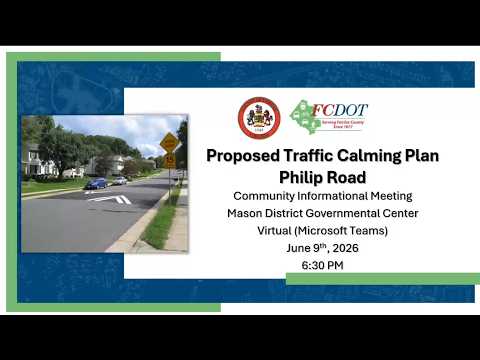
Fairfax County outlines traffic-calming plan for Philip Road; residents press for follow-up studies and cut-through relief
Summary
Fairfax County Department of Transportation outlined a traffic-calming plan for Philip Road that would add two speed humps and require a task-force ballot (19 ballots; 10 yes votes needed). Residents pressed staff on cut-through routing, follow-up counts and ballot logistics.
Fairfax County Department of Transportation presented a proposed traffic-calming plan for Philip Road on a community call that included device specifications, vote thresholds and next steps for a task-force-led ballot.
The Presenter (FC DOT) described the program’s five-step process — project initiation, plan development, community engagement, a ballot phase and installation — and said Philip Road met the program’s basic study thresholds. FC DOT reported a 24-hour combined volume of 935 vehicles on Philip Road and said the measured 85th percentile speeds were about 31 mph in the northbound lane and 35 mph in the southbound lane, satisfying the speed criterion in the southbound direction. The agency proposed two new speed humps north and south of an existing device and showed a schematic for a 12-foot-long, 3-inch-high speed hump with chevrons and 15 mph advisory signage.
Why it matters: the plan must win a task-force ballot before the county will install devices. FC DOT said the ballot area for Philip Road contains 19 occupied properties; each occupied property gets one vote, ballots must be returned directly to the Mason District supervisor’s office, and a majority of occupied properties voting yes is required to move forward. Because 19 ballots are in the area, the agency explained the project needs more than 50% of occupied properties to vote yes — in practice 10 yes votes — and non-responses count effectively as no votes. FC DOT advised a minimum three-week ballot period and recommended four weeks for a small area to allow distribution and reduce errors; at least one paper-return option is required.
Residents at the meeting raised two recurring concerns. First, they asked whether traffic calming on Philip Road will push vehicles onto parallel streets; FC DOT said it has not received reports that installations have increased volumes on neighbouring streets and noted that adjacent streets can request the program and be tested. Second, residents worried that nearby construction and routing apps could increase cut-through traffic. Staff said a separate cut-through process exists but that designating a street as local-traffic-only or compelling app providers to reroute is rare and requires sustained high volumes (FC DOT described a cut-through criterion of about 150 vehicles cutting through during a one-hour period at an intersection).
Several residents also pressed for clearer follow-up commitments after installation. FC DOT said the agency conducts follow-up studies for many projects and emphasized that speed-reduction effects are generally stronger when devices are spaced regularly rather than when a single device is installed. FC DOT recommended the task force schedule a short (about 30-minute) ballot-process meeting with staff and Mason District Office staff to finalize the ballot package and logistics.
Contact and next steps: FC DOT and Mason District office staff (Vanessa Simpson) provided contact information for follow-up (dotinfo@fairfaxcounty.gov and the Mason District Office phone) and reiterated that the task force must notify the district office when it is ready to proceed; staff will prepare the verified ballot package, and installation scheduling will follow Board of Supervisors endorsement and coordination with the Department of Public Works and Environmental Services. The task force was advised that ballots collected by the task force will not be counted and must be returned directly to the district supervisor’s office.
At the close of the meeting, staff offered to help speed the process where possible and to meet again to go over balloting procedures; no formal motions or votes were taken during the session.