Get Full Government Meeting Transcripts, Videos, & Alerts Forever!
Get email alerts on the Data Center Zoning topic
No spam. Unsubscribe anytime.
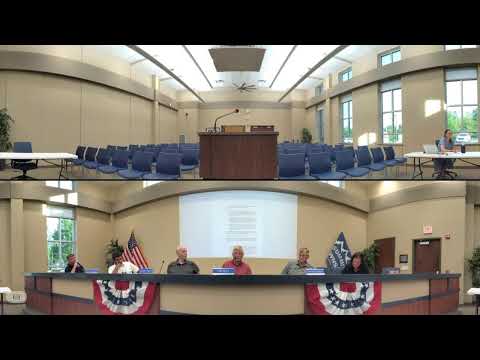
Township members press for clearer rules on data-center emissions, energy impacts and setbacks
Summary
Township officials reviewed draft data-center zoning language and flagged duplicate text, asked that air-emissions and energy-impact requirements be clarified (and not duplicate EPA rules), suggested setback benchmarks, and discussed screening standards; the meeting ended with a motion to adjourn.
Committee member said the draft contains duplicative language and unclear technical requirements during a review of proposed comprehensive-plan and zoning language related to data centers. "The plan will be prepared and certified by a professional engineer," the member said, noting the sentence appears twice and should be removed to avoid redundancy.
The committee spent substantial time on air-quality and emissions language. One committee member questioned a provision that would require applicants to "identify all stationary and motor sources" of particulate matter and nitrogen-oxide components at a site, calling the requirement "a little over the top." A staff member responded that some aspects, such as truck idling, are already covered by federal rules: "Truck idle emissions for the most part are covered by EPA regulations," the staff member said, and recommended focusing on best management practices rather than duplicating federal requirements.
Members also pressed for more precise energy-impact disclosures. A committee member asked that applicants and utilities provide "exact figures" about electricity demand and any effects on rates or availability instead of the draft's vague requirement to report only "known impacts." The member said vague language could allow future applicants to claim uncertainty: "They'd come back later on and say, 'Well, gee, we didn't know that.'"
Setbacks and screening standards drew further attention. One participant proposed starting benchmarks—350 feet from residential properties, 100 feet from other uses and a 75-foot front setback—and asked whether those distances would adequately mitigate visual impacts for nearby residents. The group discussed rooftop equipment screening and agreed that the intent (to hide rooftop equipment from view) could be met by different treatments; one member said the perforated facade used on a new state police barracks would be acceptable in lieu of a "visually solid" screen.
The group flagged several areas for follow-up: clarifying the phrase "producing air" (listed alongside dust and exhaust), confirming the jurisdictional boundaries of critical impact areas such as streams and floodplains, and asking to hear from the entity that provided the model boilerplate to understand the drafting intent. No numeric roll-call votes were recorded on these policy points.
After other business, the chair brought the meeting to a close. A motion to adjourn was made and seconded, and the motion carried by voice vote.
The draft ordinance will be revised to remove duplicative wording, clarify ambiguous terms, refine the emissions and energy-disclosure language to avoid duplication with federal rules, and return to the committee for further review; the transcript records an explicit request to obtain the drafter's intent before finalizing contested terms.