Get Full Government Meeting Transcripts, Videos, & Alerts Forever!
Get email alerts on the Budget topic
No spam. Unsubscribe anytime.
St. Pete Beach staff and commissioners hedge on $3M holding for resiliency as CIP, grants and bond options get debated
Summary
The commission reviewed the capital improvements program and revenue strategies; staff recommended holding $3 million for a top-priority resilience project pending WSP engineering results, and commissioners directed staff to scope fee studies, bond-counsel costs and grant timelines before committing major sums.
A multi‑hour capital improvements and budget workshop covered ranked projects, grant timelines and revenue options for a multi‑year resiliency program.
Staff advised placing a temporary $3,000,000 hold on a high‑priority ranked project (Project 27) while awaiting engineering and feasibility work to refine scope and matching‑grant prospects. Commissioners debated holding the full amount versus a smaller placeholder to preserve flexibility for other priorities. Finance director Devin Schmidt confirmed midyear amendments and capital reappropriations are possible if project scope and funding change.
The presentation reviewed dozens of projects—from seawalls and seawall grants at the community center and Pass-a-Grille to Blind Pass South Jetty repairs (estimate roughly $3 million), Don Cesar boat‑ramp design (budgeted design funds), Mary Pier repair/demolition uncertainty, fishing‑pier work that depends on Pinellas County timing, and FDOT‑coordinated Gulf Boulevard curb/sidewalk work. Staff cautioned that some grant awards have expiration dates and that deferring projects could require additional extension requests.
Commissioners also discussed revenue tools. The finance committee flagged several options for further study: a fire protection assessment (requires a consultant study; the estimated study cost cited in discussion was about $85,000 and the assessment would require a referendum), resilience fees or assessment models, parking/enterprise revenue bonds, tourism (TDT) capital use, public–private partnerships, and philanthropy. Commissioners supported studying an assessment or fee model to tie beneficiaries to the costs but agreed the city should await more detailed engineering and WSP study results before committing to a large bond issuance.
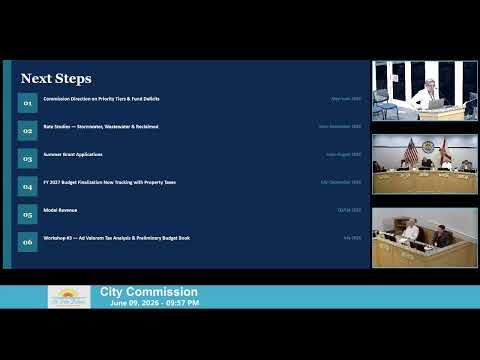
Next steps: staff will return with scoped consultant cost estimates (bond counsel, assessment studies), refined project costs informed by WSP design, and schedule options for stakeholder outreach and grant deadlines.