Get Full Government Meeting Transcripts, Videos, & Alerts Forever!
Get email alerts on the Energy Project Waterline topic
No spam. Unsubscribe anytime.
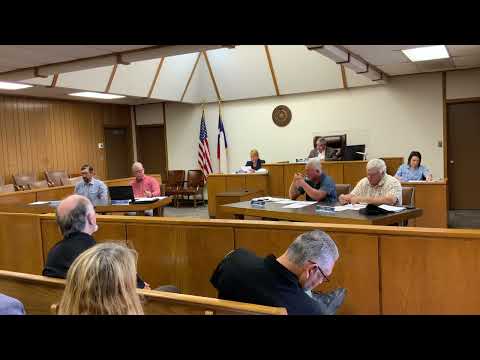
Fisher County approves easement for proposed hydrogen energy project after developer outlines water-collection plan
Summary
Commissioners approved a route easement for a developer proposing a large hydrogen/energy facility, after the presenter described water-rights acquisitions, plans for reverse-osmosis treatment, and projected pumping rates of 235–300 gallons per minute in peak production.
Fisher County commissioners voted to approve a county easement and routing for a proposed energy project that would collect groundwater from private wells along county roads 110 and 115 to support a hydrogen and power-generation facility.
During the presentation, the project representative said the developer has secured water-rights agreements from landowners along the proposed route and plans to establish a collector system and water-treatment equipment. "We have acquired rights through various land owners ... we're going to establish a collector system to put in some energy generation," the presenter said, adding the project is intended to support energy security in the region.
The presenter described treatment and reuse plans for the resource, saying the water—typically 1,800 to 2,500 parts per million in hardness—would be processed through reverse osmosis to produce water usable for industry and, in emergencies, for livestock and limited potable supply if later permitted. "Some of this water will be run through our reverse osmosis. So, it'll make good water," the presenter said.
Board members pressed for details about depletion and returns to the aquifer. The developer estimated peak production at about "235 to about 300 GPM," and discussed a reuse strategy and distributed collection from multiple wells to avoid overreliance on any single source. The presenter also said treatment-plant equipment was under purchase order and that a future petition to the Texas Commission on Environmental Quality (TCEQ) would be required if the project later sought to connect treated water to municipal systems.
Commissioners raised local-control questions about crossings and construction within rights-of-way, and one commissioner requested that pipeline crossings be encased and located off sensitive ditch bottoms. The presenter said crossings and encasements are included in plans and that the project would coordinate on routing and construction.
After discussion the board moved and approved the easement routing and county consent to proceed with route-related crossings, by voice vote. The action was procedural approval of the route and easement; the transcript records that later regulatory approvals (including TCEQ) and detailed engineering would still be necessary before potable distribution or large-scale delivery could occur.
The developer framed the project as long-term and scalable; commissioners recorded the motion, approved it by voice vote, and said detailed plan review and coordination with county staff and affected landowners would follow.