Get Full Government Meeting Transcripts, Videos, & Alerts Forever!
Get email alerts on the Public Health Infectious Disease topic
No spam. Unsubscribe anytime.
Dr. Jennawine briefs Middletown Board of Health on Ebola risks, vaccines and local preparedness
Summary
Dr. Jennawine told the board Ebola spreads by direct contact with bodily fluids, not casual airborne routes, reviewed species-specific mortality and noted FDA/WHO-approved vaccines and monoclonal therapies only target the Zaire strain; local plans and hospital designations are being rechecked ahead of increased travel.
On June 9, 2026, the Middletown Board of Health heard an educational briefing from Dr. Jennawine on Ebola virus disease and local preparedness.
Dr. Jennawine told the board that Ebola is a zoonotic viral hemorrhagic fever carried mainly by fruit bats and that human infection typically follows direct contact with infected animal meat or close contact with a very ill person or their bodily fluids. "It's not airborne," she said, adding that transmission generally requires direct contact with blood, vomit, feces or other bodily fluids.
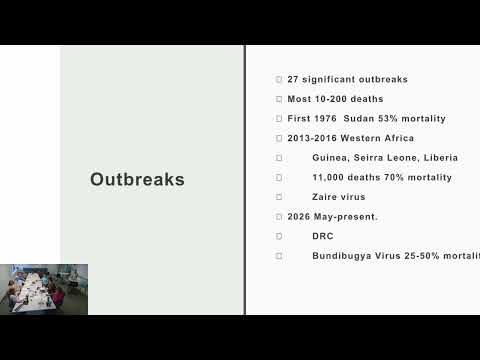
The presentation summarized clinical and public-health points: incubation ranges of about 2 to 21 days; early, nonspecific symptoms that can resemble other viral illnesses; and a progression to severe gastrointestinal loss and bleeding in serious cases. She discussed species differences and treatments, noting vaccines and monoclonal antibody therapies approved by the U.S. Food and Drug Administration and World Health Organization are targeted to the Zaire species; other species (including Bundibugyo and Sudan) have historically shown different mortality ranges.
Board members asked about the local risk from international events. Dr. Jennawine said public-health authorities are isolating and monitoring travelers and that the risk to people not exposed in affected areas remains low: "The risk is low if you're not in that area," she said. She also stressed early identification and notification of travel history in clinical settings so potential cases are evaluated quickly.
The board's medical director confirmed that all cruise-related contacts tested negative and that no local Ebola cases were identified. Health department staff said regional and hospital plans developed during earlier preparedness efforts are being updated and contacts with hospitals designated in the past as receiving sites are ongoing to re-establish protocols for patient transport and isolation.
The briefing concluded with a reminder of basic preparedness steps: education for caregivers, adequate personal protective equipment for clinical staff, and clear triage and transport pathways for suspected cases. The board took no formal action beyond receiving the briefing.