Get Full Government Meeting Transcripts, Videos, & Alerts Forever!
Get email alerts on the K 12 Education Budget topic
No spam. Unsubscribe anytime.
Grandville Public Schools presents proposed 2026–27 budget, plans 18‑mill operating levy and warns of a $584,000 shortfall
Summary
District staff proposed a 2026–27 budget that levies 18 mills for the general fund, holds debt service at 5.05 mills and projects a $584,000 deficit while relying on one‑time revenues and uncertain federal/Medicare timing to help close the gap.
District staff presented the Grandville Public Schools proposed 2026–27 budget and told the school board the district plans to levy 18 mills for the operating (general) fund, keep debt service at 5.05 mills and anticipate a modest structural deficit.
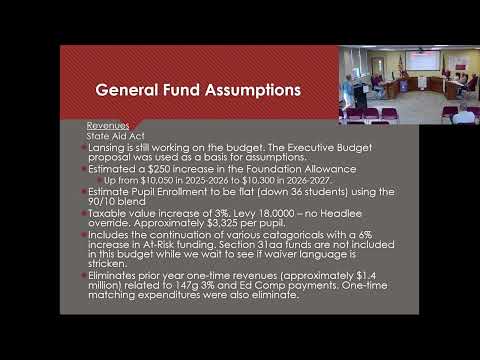
The presenter said the proposal satisfies the Uniform Budgeting and Accounting Act and reflected several legislative and local assumptions, including a $250-per-pupil foundation increase under the executive recommendation and a projected decline of 36 students for the upcoming school year. "We'll levy 18 mills," the presenter said when reviewing the operating levy; she said the sinking fund levy showed a small rollback to about 1.3433 from 1.3502.
Why it matters: district staff said the proposed spending plan would reduce adjusted fund balance below the board’s 7% policy target unless certain one-time revenues or legislative adjustments materialize. The staff projected a $584,000 deficit for 2026–27 and noted a previously reported amendment figure of roughly $1.083 million for the current year.
Budget drivers and assumptions: staff listed several variables that affect the district’s outlook — enrollment declines, categorical funding changes, one-time state payments and collective-bargaining outcomes. The presenter said categoricals such as at-risk, multilingual and special education are scheduled for a roughly 6% increase under current proposals, and that taxable revenue per pupil is about $3,300.
On one-time and timing-sensitive revenue, the presenter identified approximately $1.44 million in nonrecurring state payments that will not repeat and noted approximately $83,000 in educator-compensation pass-through dollars handled this year. Staff also said revenue from plans of care entered into MIP (Medicare billing) is expected in the fall but is not yet available; that timing uncertainty factors into whether staff reductions now could later be reversed if funds arrive.
Labor costs and staffing: staff described tentative agreements with employee groups that include a roughly 1% on-scale increase plus step and an additional off-scale payment of up to 1% (half guaranteed). The presenter noted off-scale payments are not retirement‑eligible and therefore lower legacy costs compared with on-scale increases. To address budget pressure, the district has reduced positions through attrition and cut contracted service hours effective April 1, 2026; those savings are being conservatively budgeted until invoices and fall revenue are confirmed.
Program impacts and scheduling: presenters said tight staffing has forced program and schedule adjustments at the high school and middle school. They recounted receiving calls from Ken, Tyler and Renee that "We don't have enough space for electives," which prompted posting an AP psychology position, moving staff between elementary and middle schools and cutting or reshuffling electives and PE sections to maintain core coverage.
Capital, food service and other funds: presenters said the sinking fund has supported multiple capital projects and that remaining capital dollars are proposed for technology purchases; a potential phone-system project is under consideration. Food service operations face rising costs (estimated 6–7%), mechanical needs in the high‑school kitchen and continue to support a universal free-meals policy in the budgets; staff said food service provides roughly $200,000 per year as an indirect transfer to the general fund.
Board questions and clarifications: when asked about Section 31A funding, staff confirmed Section 31A dollars were not included in the proposed budget and estimated state-projected Section 31A amounts near $830,000 for 2026–27. Staff emphasized continued uncertainty around legislative changes, potential rollbacks and the outcome of pending litigation related to funding rules.
Next steps: presenters acknowledged the proposal leaves the district below its 7% fund-balance guideline if current assumptions hold and committed to providing interim updates, amendments and a fuller picture in the fall as actual revenue and invoice data become available. No formal action on the budget was taken at the workshop; the board scheduled a follow-up workshop meeting for June 1, 2026, at 7:04 p.m.
(Reporting based on statements made during the Grandville Public Schools budget hearing; amounts and program names are those provided by staff during the meeting.)