Get Full Government Meeting Transcripts, Videos, & Alerts Forever!
Get email alerts on the Law Enforcement topic
No spam. Unsubscribe anytime.
Kentucky State Police report staffing gains, crime-lab progress and equipment shortfalls
Summary
The Kentucky State Police told the interim Judiciary Committee they have increased trained forensic staffing, reduced the sexual-assault kit backlog, made 1,625 drug arrests year-to-date and continue to need funding for a radio surge project and vehicle replacements.
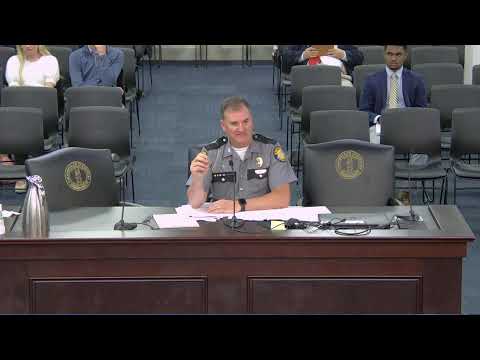
Commissioner Brettette of the Kentucky State Police briefed the Interim Joint Committee on Judiciary on recruitment, laboratory improvements, drug enforcement results and technology needs on June 9.
"We provide essential services directly to Kuckians and local law enforcement agencies," the commissioner said, listing KSP's 16 posts and specialized units, including an electronic-crimes branch and a full-time special response team. (Transcript spelling retained for the commissioner's self-identification.)
The commissioner said KSP's latest cadet class (Class 107) began with 544 applicants; 85 conditional offers were made and 81 were accepted, with 57 active in the class. He reported that the agency currently has 871 sworn troopers and that adding the class would bring staffing to about 928. He warned that 65 troopers with 18+ years of service are eligible to retire and that the agency anticipates roughly 42 retirements per year without retention measures.
On crime-lab operations, the commissioner credited recent hires in the forensic biology section with reducing the sexual-assault-kit queue from 1,295 kits (Dec. 2024) to 673 and shortening average turnaround time from 471 days to 377 days (May 2026). "In just five months, that Q... stands at 673 today," he said, citing the reduction as evidence that staffing improves throughput.
Regarding drug enforcement, the commissioner said that from January through April the agency recorded 1,625 drug arrests and seized quantities including nearly 9,000 grams of fentanyl (valued at roughly $344,000), more than 58,000 grams of cocaine (>$3.88 million) and over 178,000 grams of methamphetamine (>$1.7 million). He said methamphetamine remains the predominant lab-submission substance.
Commissioner Brettette identified two near-term infrastructure risks: the radio surge project will stop in 2027 without additional funding, and the agency needs to replace about 125 vehicles per year to maintain fleet health. He also reported improved telecommunicator staffing (194 currently employed) after pay increases and noted plans to add three drivers-testing facilities with $1.3–$1.5 million allocated in FY27–FY28.
During Q&A members asked about investigative technology and AI use (facial recognition, license-plate readers, body cameras). The commissioner said KSP has standard operating procedures governing those tools and offered to provide the SOPs to the committee. Co-chair and members also raised Ian's Law alerts (missing persons with autism), 911 routing in rural counties, and drivers-testing appointment access; the commissioner described local-state coordination and pledged to follow up on specific operational questions.
The committee thanked the commissioner and scheduled its next meeting.