Get Full Government Meeting Transcripts, Videos, & Alerts Forever!
Get email alerts on the Ref1r Project topic
No spam. Unsubscribe anytime.
Solid Waste Authority reduces Ref1R footprint, outlines air controls and 2034 operation target
Summary
Staff presented an updated Ref1R plan that reduces proposed throughput to 2,550 tons per day (three 850-tpd boilers), reserves space for carbon-capture, specifies air pollution controls to meet EPA MACT limits, and set procurement and permitting milestones through 2029–2034.
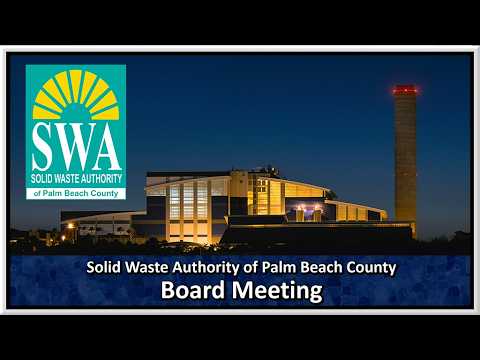
The Palm Beach County Solid Waste Authority provided a technical update on its Ref1R renewable-energy facility replacement project, reducing the planned throughput to 2,550 tons per day (three boilers at 850 tpd each) and describing requested air-quality controls to comply with recently published EPA MACT limits.
Chief engineer (speaker 6) said updated waste-generation projections—including higher diversion of vegetation and recycling—allowed the Authority to reduce the earlier facility size proposal by about 15 percent from the 3,000 tpd discussed in October 2025. The redesigned Ref1R is projected to process roughly 850,000 tons per year. Staff said the facility will include selective catalytic reduction for NOx control, a larger scrubber for acid-gas (to meet the new SO2 MACT limit), fabric-filter baghouses for particulates and powdered activated carbon injection for mercury and heavy-metal control. The design also anticipates an air-cooled condenser to save water (staff estimated nearly 1,000,000 gallons per day saved compared with current cooling) and reserves site space for future carbon-capture technologies if they prove viable at scale.
Permitting and procurement schedule: staff outlined an RFEI in August, an RFQ in January 2027 and an RFP in May 2028, with award recommendations expected in early 2029. Air-permitting packages to the state DEP are anticipated in late 2027 with draft permits in mid-2028; the earliest commercial operation is projected in late 2033 but more likely in mid-to-late 2034.
Emissions and comparison: Staff reported the smaller Ref1R footprint plus modern pollution controls would reduce emissions roughly 35 percent compared with the existing Ref1 facility, and that Ref2 is expected to meet the new MACT limits for existing plants with modest operational changes.
Public comment and alternatives: multiple public commenters and environmental advocates urged stronger recycling, commercial composting and reuse of construction materials and asked whether the smaller facility reduces the previously cited $1.5 billion construction estimate. Staff did not provide a revised total project cost at the meeting but said the reduced throughput and updated designs were reflected in the revised engineering and procurement approach. The board requested a follow-up report on equestrian-waste processing options and on whether certain residual streams could be diverted to reuse markets.
Next steps: staff will finalize legal-services agreements, continue vendor outreach, complete air-dispersion modeling and begin the permitting process; procurement milestones remain dependent on permitting and further design details.
Sources: Chief engineer presentation and the board discussion at the Palm Beach County Solid Waste Authority meeting.