Get Full Government Meeting Transcripts, Videos, & Alerts Forever!
Get email alerts on the Activity Center Planning topic
No spam. Unsubscribe anytime.
Albemarle staff outline AC44 work plan and three priority sites for first activity center plan
Summary
Planning staff told the Albemarle County Planning Commission on June 9 that five AC44 work products — zoning modernization, multimodal transportation planning, rural area planning, activity center plans and administration — will guide growth. Staff identified three priority locations for the first activity center plan: Route 29 (Airport Road→Ashwood Blvd.), Route 29 at Rio Road (Fashion Square area), and South Pantops.
Albemarle County planning staff on June 9 briefed the Planning Commission on the county’s AC44 implementation program, describing five coordinated work products to manage expected growth and naming three priority locations for the first activity center planning effort.
Staff said AC44, adopted in October and effective Jan. 1, is the county’s strategy to guide growth over the next 20 years. “We adopted AC44 back in October of last year and it became effective January 1st of this year,” a staff presenter told the commission, adding the plan estimates about 31,000 additional residents by 2044 and directs growth toward the county’s development areas.
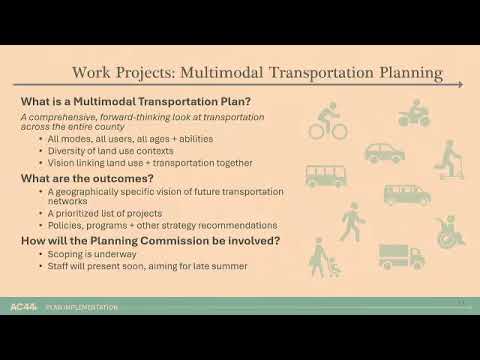
The planning department listed five core work products: zoning modernization (ZMOD), activity center planning, a countywide multimodal transportation plan, a rural area plan and AC44 administration (metrics and reporting). James (staff presenter) told commissioners that ZMOD is a multi‑phase rewrite of the county’s zoning ordinance, that the multimodal plan will be the county’s first comprehensive look at all travel modes, and that the rural plan will identify priority conservation targets such as biodiversity hotspots, agricultural lands and drinking‑water watersheds.
Why it matters: the five work products are meant to support AC44’s seven “big moves,” align regulations with the county’s growth‑management policy and focus public and private investments where they can support higher‑density, walkable, mixed‑use activity centers.
Activity center planning and the three candidate sites Ben Holt, senior planner 2, presented staff’s scoring analysis and recommended three priority study areas for activity center planning: (1) Route 29 north from Airport Road to Ashwood Boulevard (the “Airport Road” area), (2) the Route 29 corridor around Rio Road and Fashion Square (the “Rio 29” area), and (3) South Pantops east of the Rivanna River adjacent to the City of Charlottesville.
Holt summarized each site’s opportunities and constraints. The Airport Road area includes planned residential development, a county‑owned parcel with potential trail connections and nearby major private investments; staff suggested county‑led investments there (new school, county facilities, affordable‑housing funds) could serve as a northern hub. The Rio 29 area, by contrast, contains aging retail, large surface parking lots and parcels with near‑term redevelopment potential but faces heavy through traffic and high demand for county services. South Pantops was described as “destination rich” with institutional anchors and riverfront amenities but constrained by regional bottlenecks (Freebridge and Route 250 crossings) and the need for extended city–county coordination.
Commissioners’ reactions split around priorities. Several commissioners called Rio 29 a place for “low‑hanging fruit” redevelopment because it already has established commercial parcels and surface parking that could be reimagined. “It could almost be easy to create a vision for what those parking lots could look like,” one commissioner said during discussion.
Others urged prioritizing the Airport Road corridor. Commissioner Murray argued that imminent employment growth — including airport‑adjacent development, UVA and biotech activity — makes Airport Road a top priority: “I would promote Airport Road as a priority area,” he said, citing potential job growth, connections to the airport and the need to coordinate schools and multimodal links.
Staff emphasized that all three sites are likely to be studied in time and that the first selection will be chosen this summer for a focused activity center plan, with lessons applied to later centers. James told the commission, “we would be able to take a recommendation to the board later this summer on the first location for the first activity center plan.”
Key implementation details and questions raised Commissioners pressed staff on several implementation questions that will shape the work going forward: whether ZMOD will include map‑level rezoning to align zoning with the future land use map; what precedents the county will use from other localities; how the multimodal plan will incorporate pedestrian and bicyclist data (including Strava and other sources); and how activity center planning will be staffed and structured (community advisory groups, property‑owner outreach and potential incentive menus).
Staff described the sequencing: ZMOD phases will reorganize and simplify the ordinance before moving to standards that could enable zoning map changes; multimodal scoping is underway with later opportunities to seek funding (smart scale, TAP) and to coordinate with UVA and the City of Charlottesville; activity center planning will identify catalyst projects and public investments to support targeted private redevelopment.
What’s next Staff will refine the recommended first activity center study area and forward that recommendation to the Board of Supervisors in the coming months. Commissioners asked staff to ensure robust community engagement — including outreach to existing neighborhood advisory groups, property owners and historically underrepresented communities — and to consider incentives and structured parking strategies in redevelopment‑focused areas such as Rio 29.
Ending: The commission paused the presentation for discussion after the three site briefings and staff said the goal is to apply lessons from the first study to subsequent activity center plans in FY28–29.