Get Full Government Meeting Transcripts, Videos, & Alerts Forever!
Get email alerts on the Economic Development Transparency topic
No spam. Unsubscribe anytime.
Pecos council and EDC clash over transparency; council orders formal communications framework
Summary
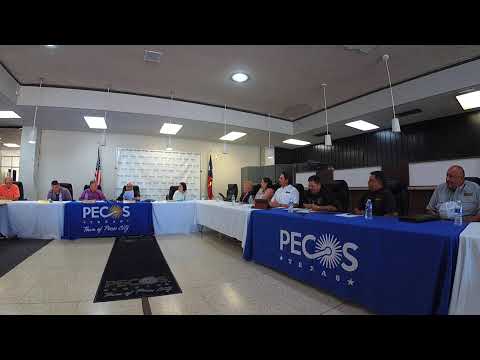
At a heated special meeting, Pecos City Council pressed the Pecos Economic Development Corporation over alleged conflicts of interest and lack of transparency around the Hidden Heroes housing project; the council directed the city manager and PEDC executive director to craft a formal communication framework within 60 days.
The Pecos City Council spent a special meeting pressing the Pecos Economic Development Corporation (PEDC) on allegations of conflicts of interest, opaque contracting and restricted information tied to the Hidden Heroes housing project, and directed the city manager and the PEDC executive director to develop a formal communication framework for review by both governing bodies within 60 days.
The push for new rules began in public comment, when Nancy Anchondo, a Reeds County resident, urged the council to “do a comprehensive forensic audit of city hall and the EDC” and to release procurement records for the Hidden Heroes project, including bids and any consulting agreements. Anchondo also alleged nepotism and asked the council to review a reported $36 million PEDC reserve; she said contractors and a consultant tied to an elected official warranted scrutiny.
The meeting quickly turned confrontational. Council members said they had been kept in the dark about a consultant who, captioned in an April 23 presentation as “working with Conrad,” appeared to thank a council member for oversight. Council members said they had not all been informed of the consultant’s ties; council members who said they had been told disputed that claim. Councilman Graham asked for a forensic audit and at one point moved to suspend the PEDC executive director pending investigation, but the chair and the city attorney noted that a suspension was not on the posted agenda and the motion was not legally in order.
PEDC leaders defended their work and the use of confidentiality agreements. David Dominguez, president of the Pecos Economic Development Corporation, said the board’s outreach had shifted the organization’s focus from retail toward larger energy and industrial investments and that multiple projects are under NDA. “We have $40 billion worth of business coming in to the community,” Dominguez said, describing power‑plant and industrial prospects the board has pursued. He and other PEDC board members said NDAs were a necessary condition for companies to disclose proprietary proposals and warned that rejecting NDAs could drive interested firms elsewhere.
Jimmy Dutch, the PEDC executive director, answered detailed questions about procurement for the Hidden Heroes project and the organization’s role. Dutch said the project had competitive bids (he cited two bids that came in near $17–$19 million and described post‑bid value engineering that lowered costs) and that the PEDC had been assigned major infrastructure responsibilities. The city manager and Dutch noted that a $2 million Housing and Urban Development grant tied to the project is restricted in how it may be used and requires accessible units, and that that grant cannot be applied to the phase where current construction is taking place.
The council and PEDC also clashed over personnel and contracting: council members alleged that a consultant had hired a council member, that the PEDC director had employed relatives, and that some contracts had been steered toward board members or affiliates. PEDC representatives said some local participation on projects had been necessary to meet timelines and that the board has previously invited council members and staff to executive‑session briefings designed to protect confidential information.
After extended debate, Councilman Graham moved and another member seconded an item directing the city manager and the PEDC executive director to develop a formal communications framework consistent with PEDC bylaws and return it for review and adoption by both governing bodies within 60 days. The council called a voice vote; the chair then moved on with the agenda and set the 60‑day timeline. The record does not contain a numerical roll‑call tally in the transcript excerpts provided.
What happens next: the city attorney said he would review any legal or ethics questions raised; the council asked staff to produce monthly financials and to report back on procurement documents and any agreements involving council members or PEDC staff. Council members and PEDC leaders both said they were open to bylaw amendments and to regular executive‑session briefings intended to supply confidential information to elected officials while protecting proprietary details for development partners.
The meeting closed with the council urging cooperation; the question of whether a forensic audit or formal disciplinary measures will follow remains unresolved.