Get Full Government Meeting Transcripts, Videos, & Alerts Forever!
Get email alerts on the Fees And Charges topic
No spam. Unsubscribe anytime.
Tigard council approves updated fees and charges, small utility and permit increases set for FY27
Summary
The council unanimously adopted Resolution No. 26‑19 to amend the citywide fees and charges schedule for FY27, applying inflationary adjustments (CPI-West and other indices), a modest 2% water rate increase and specific increases tied to regional agencies.
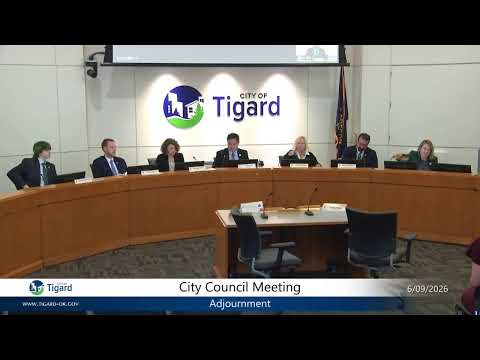
Tigard — The Tigard City Council unanimously approved changes to the city’s fees and charges schedule, adopting Resolution No. 26‑19 after a staff presentation and brief council questions.
Finance Director Eric King said the city applies several indices to set fees: the Consumer Price Index for All Urban Consumers (West) — used for parking permits, business licenses, and planning/land‑use fees — registered 2.71% for January–December 2025 and is being applied as an inflationary increase. King said a blended factor results in a 3.375% figure for solid‑waste rates driven by the franchise model in Tigard municipal code.
King explained that several increases are pass‑throughs tied to other jurisdictions: Clean Water Services adopted regional rate increases (for sanitary sewer, stormwater and related charges) that will be billed by the city; Washington County raised its transportation development tax by 8.07%. King also recommended a 2% water‑rate increase consistent with Tigard’s 2021 water‑rate study. "The average rate increases about a $4.45 increase per month," King said, and he noted roughly $2.58 of that increase is attributable to Clean Water Services charges.
Other examples in the staff slides: the largest residential solid‑waste cart (90 gallons) would see about a $1.82 increase per billing period ($3.64 every two months), and business‑license fees would rise roughly $33–$42 per year depending on business size under the 2.7% inflation factor.
Councilors asked clarifying questions about methodology and which rates are city‑set versus vendor or regional decisions. King reiterated that solid‑waste franchise haulers may include a permitted profit margin set by municipal code and that those profits do not go to the city. After questions, Councilor Schlack moved to adopt the resolution; the motion was seconded and passed unanimously by council members present.
What happens next: The adjustments will be incorporated into the city’s fee schedule for FY27. Staff said some development fees tied to the Seattle construction cost index are floored at 0% by code and therefore will not decrease despite a negative 12‑month index in the look‑back period.