Get Full Government Meeting Transcripts, Videos, & Alerts Forever!
Get email alerts on the Tif Funding topic
No spam. Unsubscribe anytime.
Skowhegan approves downtown TIF funding for parks, nonprofits after heated debate over eligibility and long-term effects
Summary
Selectmen and voters amended several warrant motions to shift community-organization funding from taxation to the downtown TIF fund. Amendments for Coburn Park Commission and the History House passed (votes recorded), prompting sustained public debate about transparency, audit status and the intended uses of captured TIF revenue.
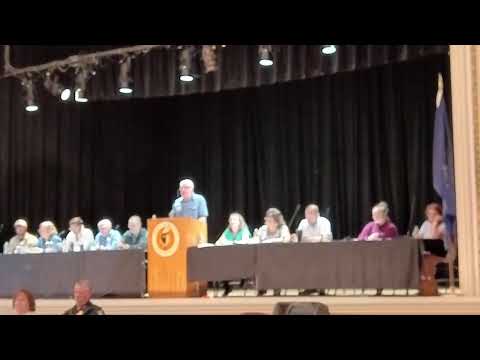
Skowhegan — At the June 8 town meeting, voters approved several appropriations for nonprofit and downtown organizations and—after floor amendments—directed some of those payments to come from the downtown tax increment financing (TIF) account rather than from general taxation.
The meeting’s budget cluster included Article 35, a $15,000 appropriation for Coburn Park Commission, and Article 36, a $15,000 appropriation for the History House. Both items began as motions to raise funds from taxation but were amended on the floor to draw the money from the downtown TIF pool. The amendment to Article 35 passed 67–31 (amendment vote recorded in the meeting) and the Article 36 amendment passed 53–36; both amended main motions carried as presented.
Amber, chair of the downtown advisory/TIF committee, explained the state contract that governs the downtown capture and listed qualifying uses, including infrastructure (parking, sidewalks, lighting), certain arts/culture infrastructure upgrades and marketing. She said the TIF account stood at roughly $240,000 after the March capture and that the board proposed designating up to $190,000 to offset community-service requests, leaving roughly $50,000 for usual advisory‑committee grants if those designations were approved.
Opponents warned that using captured downtown value for recurring operating assistance risks shortchanging infrastructure priorities and asked for more fiscal transparency. One commenter noted the town had not posted audits for recent years and said that redirecting TIF funds without a clearer plan could be “a shell game” that shifts tax burdens elsewhere in the long term.
Supporters argued that many community organizations qualify under the state contract and that modest use of captured funds can reduce near‑term tax pressure while still supporting downtown objectives. The select board and volunteers also discussed procedural clarifications: applications to the TIF advisory committee, typical per‑project thresholds, and the 30‑year time horizon for the downtown capture (the TIF was formed in 2006 and runs through 2035 under the state contract).
After debate and recorded amendment votes, the meeting approved a series of items that were amended to use downtown TIF funds for at least some of the requested amounts. Other items (for example, an $85,000 Main Street appropriation) remained funded from taxation after discussion of eligible uses.