Get Full Government Meeting Transcripts, Videos, & Alerts Forever!
Get email alerts on the Budget Amendment topic
No spam. Unsubscribe anytime.
Hudson County announces $1.31 million budget amendment for legal services, rental assistance and food security after public hearing
Summary
Hudson County Executive’s office proposed a $1.31 million amendment to the 2026 county budget — $150,000 for constituent legal services, $160,000 for food pantry providers and $1 million for rental assistance — and commissioners set a timetable for introduction and public hearing amid broad public support and calls to ensure accessibility for immigrant families.
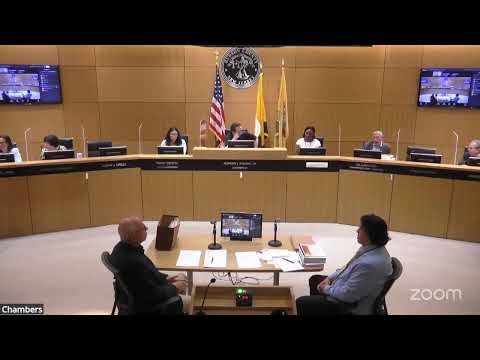
Hudson County commissioners heard public comment Wednesday on a 2026 budget amendment introduced by County Executive Craig Guy that would add $1.31 million for legal services, rental assistance and food security programs.
Alberto Rico read a statement from the county executive announcing the amendment and detailing the allocations: $150,000 to the Hudson County Law Department for constituent legal services, $160,000 to the Office of Food and Health Equity for food pantry providers, and $1,000,000 to the Office of Family Services and Reintegration for rental assistance programs. "This amendment allocates an additional $1.31 million in additional funding for legal services, rental assistance, and food security programs," Rico said while reading the executive’s statement.
The board clarified that the budget would not be adopted at Wednesday’s meeting. Commissioners and staff said the plan is to introduce the amendment on Thursday, present the amendment to the state Department of Community Affairs for review, hold a public hearing two weeks later (announced during public comment for June 23 at 6 p.m.), and then consider adoption depending on outstanding state funding determinations.
Speakers at the public hearing urged the board to move quickly and to write eligibility rules and procurement language so funds reach those most in need. Courtney Walker, a Jersey City resident, asked when the amendment would be voted on and thanked commissioners for locating additional funds; the administration replied that introduction was planned for Thursday and that a June 23 public hearing was scheduled. "We think we'll be able to [adopt the budget], but we don't quite know that yet," staff said, citing an unresolved state funding issue.
Advocates who spoke emphasized administrative accessibility and broad eligibility. Maya Bontan Areronov, an organizer who works with immigrant households, urged the county to design rental and legal assistance so residency rather than citizenship would determine eligibility, to remove paperwork and scheduling barriers for working residents, and to fund attorneys able to handle holistic immigration cases (for example, U visas and court representation). "We need to be creative ... so that folks who really need the support ... don't get bogged down in that administrative burden," she said.
Several speakers detailed the human effects of ICE detentions and deportations and the limits of current service providers. Maya Lauer, coordinator for a family support program, offered anonymized case examples of families who had been left without income or legal representation after detentions and urged commissioners to fund services that can reunite and stabilize families. She said some local legal providers have limited intake days or closed wait lists and that rental programs often restrict aid to citizens.
Commissioners pledged to craft procurement language and an RFP for the legal-services allocation and to share drafts with advocates. One commissioner said county council would ultimately develop the RFP and asked advocates to provide contact information so county staff could coordinate. Officials also discussed how to sustain services beyond the initial allocation, noting that $150,000 for legal services will require a procurement process and careful planning to ensure ongoing representation for cases that may take months or years.
Public commenters from community groups and residents repeatedly urged flexibility in eligibility and distribution practices, greater capacity for service providers and expedited timelines given families already in limbo. "We are grateful that you have been willing to explore ways to integrate us into the county workforce and to consider ... allowing us to be made whole as we move into county employment," said David Morel, vice president of the HCSC CDC Association, raising a separate but related workforce-transition concern (see separate coverage).
Next steps: the county intends to present the amendment to the Department of Community Affairs and introduce the measure Thursday; a follow-up public hearing was scheduled and the county said it may adopt the amended budget at the subsequent meeting pending DCA review and any outstanding state funding confirmations.