Get Full Government Meeting Transcripts, Videos, & Alerts Forever!
Get email alerts on the Land Use Zoning topic
No spam. Unsubscribe anytime.
Zoning board delays decision on Pine Grove solar project after notice error; applicant seeks 105-foot setback variance
Summary
The Zoning Board of Appeals kept the public hearing open on a proposed Pine Grove solar array after a mailed notice listed the wrong start time. The applicant now proposes panels 25 feet from the property line — a 105-foot variance from the 130-foot requirement — and will provide DEC/Army Corps permitting updates, photos and a site visit before February.
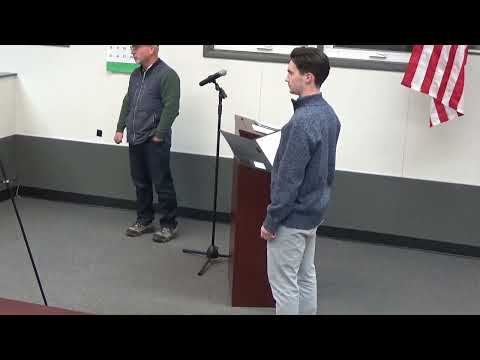
The Zoning Board of Appeals on Wednesday continued public review of a proposed solar array in the Pine Grove area after discovering the applicant’s mailed notice listed the meeting at 7:30 p.m. instead of the scheduled 7 p.m., and after board members requested more documentation and visual materials. The board set a continuation for the first Wednesday in February at 7 p.m.
The applicant told the board the array’s panels would be 25 feet from the property line, and acknowledged that represents a request to reduce the current 130-foot zoning setback — a 105-foot variance. Project team members also briefed the board on wetlands and permitting: they said the state Department of Environmental Conservation (DEC) signed a map showing limited jurisdictional wetlands and that the team plans to pursue a project jurisdictional determination/termination and to seek coverage under the Land-Based Renewable Energy General Permit. The applicant characterized most construction impacts as temporary (driven/drilled piles) and said the only anticipated permanent impact would be the roadway access area, estimated at under one-tenth of an acre.
Why it matters: The setback variance and wetlands permitting determine whether the project can be sited as proposed and what mitigation will be required. Nearby residents raised concerns about sight lines and potential visual impacts; the board asked for photos from the applicant showing adjacent homes and for a coordinated, controlled site visit with the landowner’s permission.
At the meeting the board and applicant clarified several technical points. Applicant representatives said typical in-row spacing for panels ranges between about 19 and 25 feet and that the current layout change reduced a southern block of panels while moving some rows closer to recover panel count. On setbacks, the panel setback (not the fence) is the measure the variance request addresses. For wetlands, the applicant explained that driven piles and drilled posts are typically treated as temporary impacts by the U.S. Army Corps of Engineers and that the project would use timber mats during installation and remove or relocate them (generally within about 90 days) to reduce permanent disturbance.
Public comment included a local resident, Alan Breakerhoff of 302 Gro River, who said a solar array would be preferable to housing developments or heavy commercial uses and asked who enforces zoning compliance. Board members explained that routine use compliance and building inspections are handled by the building department, and that the zoning board’s role is to decide area or use variances when a proposal does not meet dimensional or use rules.
What the board asked for before the next hearing: DEC project-jurisdiction documentation (project JD or project jurisdictional termination letter), confirmation of the distance from the array to the named nearby stream, additional photos showing sight lines to adjacent residences (especially the lower/southern area), and coordination for a site visit with property-owner permission. The board agreed to keep the hearing open to ensure members and the public have adequate opportunity to review the materials before any variance decision.
The board recorded procedural motions on the agenda: approval of prior meeting minutes, opening the continued public hearing for the Pine Grove solar project, and a motion to continue the hearing to the February meeting. All motions were carried by voice vote; no roll-call tallies were recorded at the meeting.