Get Full Government Meeting Transcripts, Videos, & Alerts Forever!
Get email alerts on the Land Use Zoning topic
No spam. Unsubscribe anytime.
Cheshire approves zoning change to let indoor wedding venue at Norton Farm, caps indoor attendance at 275
Summary
The Planning & Zoning Commission voted June 8 to adopt a zoning text amendment allowing an indoor event venue on farms that place at least 60% of acreage under a permanent restriction; the approval reverts proposed outdoor-event expansions and adds a 275‑person cap for indoor events, with site-specific rules to follow at special permit.
Cheshire — The Planning & Zoning Commission on June 8 approved a change to the town’s zoning regulations that clears the way for a year‑round indoor event venue at the Norton Brothers Fruit Farm property (now marketed as Kelly’s Farm) provided most of the farmland is permanently protected from development.
The amendment, filed by applicant Kelly Farms LLC (formerly DEWC LLC) and presented by attorney Christopher Russo and principal William Cunningham, requires that at least 60% of contiguous acreage be subject to an easement or other recorded restriction prohibiting future development as a condition for special‑permit approval of indoor events. Commissioners amended the petition on the floor to keep the town’s current outdoor‑event limits in place and to cap the total indoor attendance at 275 people; the commission then approved the amended language by voice vote.
Why it matters: Applicants said the indoor venue is intended as an adaptive‑reuse strategy to make farming on the Norton property viable by creating a reliable revenue stream. Opponents told the commission they fear traffic, noise, and commercialization of a residential area; supporters said conservation combined with a modest indoor venue is the only realistic way to prevent a 25‑lot subdivision that would remove the farm entirely.
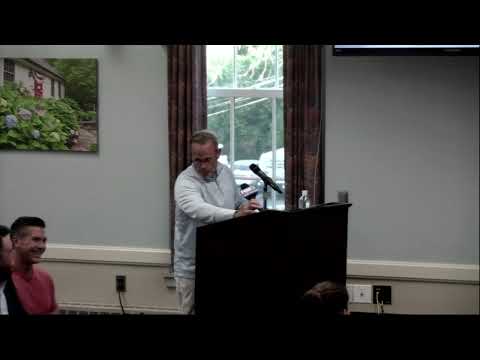
Applicant and plan: Christopher Russo of Pullman & Comley, representing Kelly Farms LLC, introduced William (Bill) Cunningham, who described the purchase of the property as an effort “to try to save the farm.” Cunningham told the commission he has discussed a conservation easement arrangement with the town, state and a land trust and said the group is seeking roughly $2.5 million to fund a permanent restriction on development rights. Cunningham described a timber‑frame, highly insulated indoor barn to host typical wedding receptions of 120–200 people and stated the building would be soundattenuated; he said parking plans would include roughly 130 spaces.
Concerns and concessions: Several residents urged the commission to retain limits on outdoor events, to restrict simultaneous outdoor and indoor uses and to set hard attendance caps. Peter Grant, a nearby resident, told the board that the application as written appeared to eliminate prior weekly and seasonal limits and warned it could generate “dramatically increased traffic and noise.” In response, the applicant agreed to limit indoor capacity to no more than 275 attendees and commissioners amended the motion to revert the proposed outdoor‑event expansions to the town’s existing rules; detailed restrictions (hours, noise thresholds, parking and traffic management) were left to the special‑permit and site‑plan review stage.
Legal and funding questions: Commission members and town counsel clarified that the text amendment requires a recorded restriction prohibiting development but does not specify which entity must hold it; a restriction could be held by the town, a land trust, the state or another qualified holder. The commission noted that any town funds or purchases of development rights would be decisions for the town council, not the zoning body.
Public record and next steps: The hearing included dozens of public comments both supporting and opposing the amendment and several written letters were added to the record. The text amendment now returns to the file with the commission’s approved language; if an applicant later files for a special permit for a particular site plan and building, the commission will consider conditions (noise limits, limits on simultaneous events, parking/traffic mitigation, and monitoring/reporting) at that time.
A note on numbers: Cunningham told the commission the developer previously paid $3 million for the property and that he paid “about $5 million” to acquire it to preserve the farm; in the transcript he also recited other cost estimates — $2.5 million sought for the easement, $500,000–$600,000 to repair the farmhouse, roughly $300,000 for farm equipment and several hundred thousand dollars to restore the retail store — which he presented as part of the finance rationale. Where the transcript record was imprecise on an exact purchase figure, the commission’s decision focused on the easement requirement and on site‑specific conditions rather than relying on a precise purchase price.
What the vote did: The commission’s amended motion explicitly: (1) left the town’s existing outdoor‑event time and frequency limits in place; (2) allowed indoor events year‑round where the 60% development‑restriction condition is met; and (3) capped indoor attendance at 275. The board approved the motion and closed the public hearing; the transcript records the vote as passing without opposition.
The next step for the applicants will be filing a supplemental special‑permit/site‑plan application for the proposed indoor structure and parking, at which point the commission expects to set detailed operational conditions and monitoring requirements.